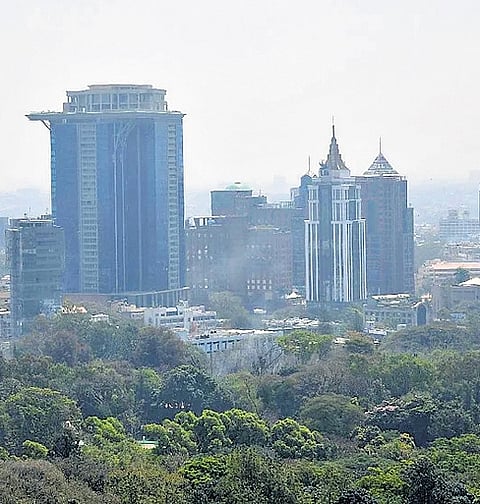

BENGALURU: Bengaluru’s concrete cover is a solid 87.6 per cent, having increased by 10 per cent over the past decade. This has had a multiple effect on the city, leading to the creation of many heat archipelagos, a rise in temperatures and greenhouse gas emissions, besides affecting citizens’ health. A cluster of urban heat islands within a city or region is called an ‘urban heat archipelago’ and represents the combined effect of multiple localised heat islands, forming a broader area of elevated temperatures.
A micro-level study of Bengaluru’s landscape ‘Urban Heat Island Linkages with the Landscape Morphology’, released on Tuesday, shows that lakes and trees cover a mere 12 per cent. The report, prepared by researchers from the Centre for Ecological Sciences, IISc, pointed out that increase in concretisation is also a reason for many diseases, including heart attacks and lifestyle disorders.
Prof TV Ramachandra from IISc, co-author of the study, said there is a direct relation between reduction of lung spaces, increasing concretisation and deterioration of health. “During the study, we found that the basic criteria of ensuring 30 per cent setback (thermal comfort space as architects call it) remains only on paper while seeking plan sanction from civic authorities. These thermal comfort zones not just help regulate urban temperatures, but also ensure good health. Corruption and lack of checks on the ground is the reason for this violation. It also leads to urban flooding,” he said.
The report showed that urban green islands like the GKVK, IISc and Jnanabharathi campuses are also being compromised. For the study, researchers used temporal remote sensing data (from 1973 to 2025) through supervised non-parametric classifier. The report stated that the built-up area increased from 7.97 per cent (1973) to 87.64 per cent (2025).
Bengaluru saw a boom in spatial expansion from the year 2000 with the formation of BBMP, when adjacent rural areas were incorporated and agricultural lands were converted to paved surfaces. “The city’s landscape saw a 1078 per cent increase in built-up area, and a decline of 88 per cent vegetation cover and 79 per cent water bodies, leading to the transition from porous to paved surfaces, affecting the hydrology, ecology and socio-economic aspects,” Ramachandra said.
The urban growth trajectory of Bengaluru as of 2025 is 90 per cent, and has been on the rise since 2021. “The primary driver of urban expansion is unplanned urbanisation, which has led to converting green (agricultural land etc.) and blue (water bodies) spaces into residential and commercial areas. The urban growth trend analysis revealed that Bengaluru’s landscape is almost near saturation, surpassing its carrying capacity,” the report stated.
Ramachandra pointed out that due to increased concrete cover, there has been a rise in land surface temperature and there are no more non-hot or cold spots in Bengaluru, which existed till the 1990s and early 2000. Studies showed that land surface temperatures are high and the threshold values for hot and cold spots is now 44 degrees Celsius and 35 degrees Celsius, respectively.
