
The scene unfolds in a calm rural setting. A young and radiant Krishna stretches playfully across Yashoda’s shoulder, his frame relaxed against her as she bends forward to milk a cow. The life-like Yashoda and Krishna, having been painted in the 1890s, is created by Raja Ravi Varma, one of India’s most celebrated artists. This oil-on-canvas masterpiece’s recent record-breaking sale has drawn fresh attention to his legacy and placed Indian art firmly within a global spotlight. At a recent Saffronart auction in Mumbai, the work went under the hammer for Rs 167.2 crore, surpassing MF Husain’s Untitled (Gram Yatra). The artwork was acquired by billionaire-industrialist Cyrus Poonawalla.
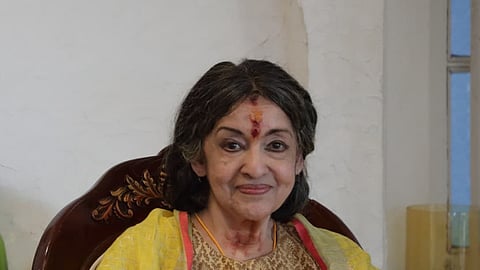
For Bengaluru-based artist Rukmini Varma, the great-great-granddaughter of the master painter and a member of the Travancore royal family, the moment brings a strong sense of pride along with recognition that has been building over time, as she effuses, “It was a moment of extreme joy with a deeply personal element to it realising that my great-great-grandfather’s work has received a recognition long overdue. This is especially so since Ravi Varma’s signed paintings indisputably attributed to him are rare to surface at auctions today. The price was more than justifiable.”

Though she has not personally seen this particular art work of Raja Ravi Varma, she says, she was familiar with most of his works since childhood as she reminisces, “My grandmother (Maharani Sethu Lakshmi Bayi), his eldest granddaughter, had many of his originals which were later distributed among her progeny. This particular work was not among them, however, we knew of its existence from images we had of his works.”
Rukmini further points to the artistic strength of the work, drawing attention to the precision and care visible across the canvas. What appears to be a simple moment carries a depth that holds the viewer’s attention. “Artistically speaking, it has, in all of his works, a faultless composition, placement of subject, colour value, perspective and visual satisfaction. An ordinary rural scene, a woman milking a cow and her child waiting for milk nearby, becomes an extraordinary piece of art in the hands of a master artist. Ravi Varma had this gift of turning a mundane act into an extraordinary celebration with his brush,” the artist adds.
Rukmini, who is also the chairperson of the Raja Ravi Varma Heritage Foundation founded in 2015, highlights the responsibility that comes with inherited legacies, noting that preserving them has become increasingly challenging in the face of modern-day demands. In her view, placing such works with credible institutions, along with sharing the knowledge attached to them, helps ensure that the artist’s legacy continues to be sustained and accessible to art aficionados. Her progeny, Jay Varma, is now carrying the family’s artistic legacy forward. “Families of artists ought to be responsible for the preservation of the legacy left to them, but this is not easy today with the demands of modern living, hence the best method would be to entrust it to notable institutions and supply the information they have to continue the name and work of the artist for not only themselves but for the world,” she says.
Raja Ravi Varma, born in Kilimannoor, was tied to the Travancore Royal Family through his marriage to Bhageerathi Bayi of the Mavelikkara Royal House. Though the Travancore royal family ruled southern Kerala, their presence extended to B’luru. Dynasty members established ties with the city through residence and property ownership, including a guesthouse on Cunningham Road. Following the abolition of the princely states and her reduced role, Sethu Lakshmi Bayi, who ruled as regent (1924-31) during the minority of her nephew Chithira Thirunal Balarama Varma, moved to the city, constructing a bungalow near her daughter’s home, where she spent 25 years. Her family settled on Richmond Rd, transforming part of the royalty into Bengalureans. Notably, the Raja Ravi Varma Heritage Foundation, connected to the lineage, is situated on the heart of the city on Lavelle Road.