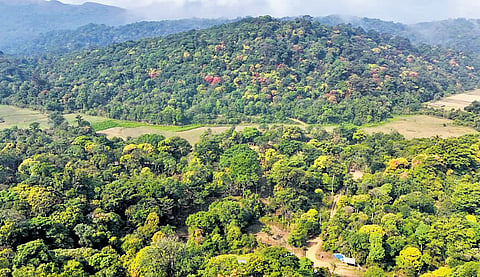

MADIKERI : Mycelium Ecology, a Kodagu-based conservation entity, has launched a unique unconventional initiative to protect the healthy habitats in this part of the iconic Western Ghats.
As a private limited company, Mycelium Ecology buys ecologically-sound private properties directly from their owners,preventing these critical ecosystems from falling into the hands of resort developers or new planters or other forms of destruction.
Under its flagship project, ‘The Dancing Frog Habitat’, the company has protected 70 acres of pristine land in Kodagu.“Schools of thought see Kodagu as a landscape that looks fantastically green.But not everything green is actually healthy,” Abhishek Jain, co-founder of Mycelium Ecology, told TNSE.
Faced with this reality, co-founders Abhishek Jain and Nishanth Prasannan held extensive discussions with fellow conservationists to explore how they could meaningfully intervene. The duo was reluctant to rely on contemporary conservation models, which suffer from lack of proven results or have shaky long-term continuity.
Instead, they registered Mycelium as a private enterprise, allowing like-minded individuals to become equity shareholders in conservation collectives.According to them, conservation fails when economics don’t work. This model ensures they reinforce each other.Their strategy is straightforward, yet ambitious –buy pristine private land and permanently safeguard it from development or other anthropogenic pressures.
“We decided that acquiring critically important, healthy ecosystems and taking them off the market is the most sustainable way of conserving landscapes that last generations,”Abhishek said, adding that the overarching goal is to create an ecological impact that transcends time.
After spending years scouting threatened landscapes across Kodagu,the team identified a piece of land that is now being nurtured as the ‘Dancing Frog Habitat’. “We bought this 70-acre land from its owner, who was being pursued by a few buyers for a big resort project, which would have resulted in the destruction of this pristine landscape,” said Abhishek.

Rather than relying on donations or CSR grants, Mycelium Ecology raised funds by taking loans and eventually inviting conservation-minded individuals to invest directly in the company and protect nature in that piece of land as a group of custodians. One of the first custodians is Vinod Chandramouli, who is also one of the co-founders working full-time with Mycelium Ecology. The business model strictly moves away from standard real estate ventures as investors buy equity in the company rather than individual plots of land.
“We are not a real estate company; we don’t cut up land into plots to sell. We work with local communities on traditional ways of coexistence and apply best practices into our conservation practices,” Nishanth said.
“Shareholders become guardians of the habitat, holding the land as a permanent, unified asset. While working with native communities, with a responsibility of enabling biodiversity conservation, these guardians are provided with a beautifully designed residential space of their own, but no individual owns the land,” he said.
‘The Dancing Frog Habitat’
The project has been designed to prove that eco-conscious living can be financially self-sustaining without compromising ecological integrity. At ‘The Dancing Frog Habitat’, Mycelium strictly caps human infrastructure, including roads, pathways and structures, to less than 1.5% of the total landscape. On this 70-acre property, construction is limited to around 30,000 sqft and the remaining 98.5% of the land stays completely undisturbed as natural habitat rich with native flora and fauna. The company restricts the use of heavy machinery or large earth-moving machines on the land and builds low touch, least intrusive residences, with eco-friendly materials for the guardians of the land.
“We want to build mindfully and ensure that the process of construction has minimum long-term impact on the landscape. Normally, building a house would mean a lot of modifications such as cutting the slope, bringing down trees within a radius of 30 ft around the house and we do not want to introduce non-native plant species into the landscape just for aesthetics,” Nishanth said.
“Humans are part of nature and let’s not look at human presence and nature as mutually exclusive. Coexistence can be and has to be done responsibly,” Abhishek said.
For Mycelium’s shareholders, buying pristine land and leaving it alone is the highest form of conservation. Rather than over-managing the landscape, the collective prioritises ecosystem preservation and non-interference. “Ecological process and the web of life on this 70-acre property is functioning as nature intended,” Abhishek said.
“We don’t have to manipulate nature. We just have to ensure this land never falls prey to human greed,” he added.
By creating a replicable, financially viable model for private land protection, Mycelium Ecology hopes to make nature conservation accessible to every citizen who wants to help protect Western Ghats’ biodiversity hotspots. “Conservation should ideally be a way of life and not a job for few. Our concept is anchored on three simple words - ‘Observe’, ‘Interpret’, and ‘Nurture’, because we humans are part of this ecology and there still is so much more to learn from nature,” Nishanth said.
In a region caught between rapid development and environment fragility, Mycelium is offering a fresh alternative to nature conservation. In its first conservation initiative of ‘The Dancing Frog Habitat’, nature is left to write its own future. The company is promoting the most simple concept of conservation: protecting nature is sometimes as simple as buying land and leaving it undisturbed.