
If you were (or still are) a fan of MasterChef, you’d remember the dark chocolate sphere or white chocolate flower that opened its heavenly doors to a plate of dessert at just a drizzle of a syrup. When it comes to garnishing these plates, especially in luxury restaurants and hotels, artistry and precision add necessary versatility, notes of flavour and visual appeal to a dish. The attention to detail is such that even experienced pastry chefs admit chocolate keeps them on their toes. Dominic Gerard, executive chef, 080 Lounge operated by TFS at Kempegowda International Airport recalls a World Chocolate Day dessert display where an elaborate chocolate showpiece lost its structure after remaining outside ideal conditions longer than planned. The incident reinforced the importance of timing, prompting the team to assemble delicate chocolate elements only at the final stage. Abhinav Singh, executive pastry chef, Shangri-La Bengaluru, too, recalls a VIP gala where the kitchen’s air-conditioning failed. “Fifty intricate, hand-piped chocolate cages collapsed into puddles just three minutes before the grand dessert course was wheeled out,” he recalls.

On World Chocolate Day, chocolate continues to nudge chefs beyond the boundaries of creativity.. Delicate curls, paper-thin shards, intricate lacework and sculptures are designed to do all the talking. “The garnish should never feel like an afterthought. A crisp chocolate shard, a delicate tuile or a light chocolate curl can completely change the first bite by adding contrast and texture. It’s about creating a moment where one experiences something unexpected before discovering the rest of the dish,” says Kardam, corporate chef at PIXI.
Creating these delicate-looking decorations is as much engineering as artistry. Its strength lies in precise and thoughtful design and a whole lot of understanding of how it will travel from kitchen to table. Executive chef Amit Sharma of Hilton Bangalore Embassy Golf Links explains that every decoration begins with structural thinking. He likens the process to architecture, as he shares, “The form has to carry its own weight, so I work the way an architect would: arches, interlocking nodes and curved spiral structures where cracks are less likely to begin. A curve is far stronger than it looks. Physics decides what survives and the aesthetic works within that.” Technologies such as 3D food printing are also opening up new possibilities for creating intricate lattice work with greater precision.
Behind every successful chocolate decoration lies one crucial step: tempering. Gerard says carefully heating and cooling it stabilises cocoa butter crystals, giving the chocolate a glossy finish, clean snap and the strength needed for intricate work. “Without proper tempering, chocolate turns dull, streaky or soft and won’t hold the shape. Temperatures have to be handled carefully because a small variation can affect the result,” he says.
Texture and finish play a defining role in how chocolate catches the eye. A crisp chocolate disc over a mousse or a tuile paired with a creamy custard or an airy shard alongside soft cake creates contrast from the first mouthful of indulgence. Chef Priyank Singh Chouhan, culinary director, Shiro, Hard Rock Cafe and Yoichi, says every garnish is designed with the same purpose. “A crisp snap, light crunch or smooth melt can complement the dessert or drink. The garnish should enhance the first bite or sip, add visual appeal and balance the overall taste without overpowering the main dish,” he adds.
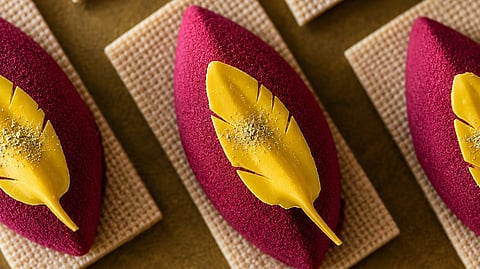
Matte cocoa butter sprays, glossy glazes, velvet finishes and metallic accents each interact differently with light. Sharma says pairing contrasting finishes creates greater depth on the plate, while natural pigments such as matcha, beetroot and spirulina are becoming popular alternatives for colouring cocoa butter. Edible flowers, matcha and spices are pressed into chocolate sheets or infused into decorative elements to drop subtle hints about the flavours waiting underneath. Singh says that ingredients such as micro-flowers, matcha powder and ground star anise are pressed into semi-set chocolate sheets to create ‘a striking visual mosaic that mirrors the dish’s flavour profile’, as he adds, “We contrast a velvety cocoa butter spray with strokes of high-gloss gold dust to catch the warm ambient dining lights, creating visual depth and drama.”
While it may sound unconventional, chocolate is increasingly making its way into savoury dishes and cocktails as well. Dark chocolate paired with unconventional pairings like herbs and spices sometimes takes a better turn than a diner’s expectation. “I move away from dessert-style finishes and instead use darker chocolate with herbs, citrus zest, spices and smoked elements. Those visual cues prepare diners for a savoury experience,” says Kardam.