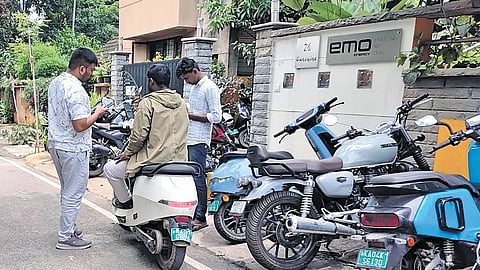

BENGALURU: As Namma Bengaluru continues its explosive growth, urban development must adhere to a robust planning framework to ensure that residents enjoy the quality of life they deserve. A fundamental component of this framework is land-use zoning. Just as a well-designed home has separate spaces for living, cooking and rest, a city functions best when residential, commercial, industrial and public spaces are clearly defined and appropriately regulated, say experts and residents.
While the most discussed and widely known consequences are traffic congestion and parking shortages, Nitin Seshadri of Koramangala 3rd Block Resident Welfare Association argues that the impact extends further.
“Commercial activity places significantly greater demands on water supply, sewage systems and electricity infrastructure than these areas were originally designed to support. It also introduces higher levels of air, water and noise pollution, undermining the peace and tranquillity that residential areas are intended to provide,” Seshadri said.
Executive member of North East Residents’ Welfare Association Christopher S Cruz said zoning violations erode the promise of model residential layouts. “When HRBR, HBR and OMBR layouts were conceived in the early 1980s, they represented a forward-looking vision of quality urban residential living. Inspired by well-planned residential developments in Singapore, these neighbourhoods were designed with broad roads, wide footpaths, civic amenity (CA) spaces, and clearly designated commercial zones. Marketed as premium ‘model residential layouts’ at premium prices, sites were allotted by Bengaluru Development Authority (BDA) with a clear stipulation: plots were to be used strictly for residential purposes only,” Cruz said.
He, however, said that over time, this foundational principle of ‘residential purpose only’ has been steadily undermined. He complained that Greater Bengaluru Authority (GBA) officials, instead of upholding the original zoning framework, have selectively misinterpreted the criteria for permitting commercial activity to a simplistic and misleading benchmark of a 40ft-wide road.
“This false interpretation ignores core zoning rules. In fact, nearly all roads in these layouts meet this width criterion; that was part of the original design. It was never intended to open the door for commercial use in every street,” he lamented.
Converting homes into business units
The issue of commercialisation of residential areas echoes across residential bylanes of the city, like Koramangala, Malleswaram, Jayanagar, JP Nagar, Chamarajpet, Basavanagudi, Indiranagar, CV Raman Nagar, AECS Layout, BTM Layout, Kalyan Nagar, HBR Layout, Hebbal, Basaveshwarnagar, to name a few. Residents complained that several property owners, for the greed of earning additional income by leasing their properties to commercial tenants, showed little regard for the inconvenience and impact caused to nearby residents.
“A growing number of residential properties have been converted -- formally or informally -- into offices, restaurants and other commercial establishments. This transformation typically begins with property owners misclassifying their homes as commercial units during self-declared property tax filings. These tax receipts are then used to obtain commercial electricity and water connections, and to reassure prospective tenants that the property is legally fit for business use,” Cruz said.
Throwing light on some of the less-discussed impacts of commercialisation, he said, “Commercial establishments generate exponentially more waste, often 15 to 20 times that of a typical household.
Existing garbage collection systems, designed for residential volumes, are quickly overwhelmed. In many cases, waste collection vehicles reach capacity after servicing just a few such properties, leaving surrounding homes unserved. The excess waste frequently ends up on roadsides or vacant plots, creating “black spots” that attract stray animals and rodents, raising public health concerns.
Gilbert Millicent Nathan, a Koramangala 4th Block resident, said a residential building on a 30ft road, 3rd Cross, 16th Main Road, has been occupied by EMO EV, a battery company, to conduct R&D, testing, and assembling of batteries for the past two years, creating security and privacy issues for residents.
“The staff talk loudly and operate machines during the day, causing nuisance and disturbing our routine activities. Every day, nearly 30 bikes and 4-5 cars of their staff are parked in front of the building and nearby houses, causing problems for the smooth movement of vehicles of the street residents, creating an unpleasant sight and encroaching on open spaces,” he said.
Gilbert, a father of two daughters, added, “Since the building is directly opposite my house, the staff face my bedroom windows (on ground and first floor) and work till late in the evenings and night. It is very uncomfortable, we don’t have privacy and are forced to keep our window curtains drawn to avoid being watched.”
His complaints to GBA and the jurisdictional Koramangala Police Station have not yielded any results. “GBA has issued a notice on the grounds of zonal violation, to vacate the premises within 7 days, failing which the premises will be sealed. However, business continues,” he said.
Ancillary businesses permitted
Residents like Gilbert say that small businesses such as vegetable/grocery shops, clinics, salons, bike repair, tuition classes etc that serve locality residents, falling under the ancillary category permitted in residential areas, are allowed on 40ft and wider roads, but strictly no such activity is allowed on a 30-feet road.
Residents complain that a large number of workers operating adjacent to their homes, with goods vehicles arriving for loading and unloading materials, create noise and disturbance, disrupting the peace of what was once a quiet neighbourhood.
Gilbert also lamented that other neighbours who should have joined him in his fight have turned a blind eye to the deteriorating situation. “They have formally given no-objection to their activity for some favours. If these violations are allowed to continue, there will be more such businesses entering residential areas for low-rent premises, and it will become difficult to clear them in future,” he warned.
By their own admission, Gilbert said the company hosts drinking sessions for its staff regularly on their terrace, and justifies it saying they are doing so within their building. “Imagine 35-40 people consuming alcohol in a residential building and coming out on to the streets late at night. What safety and privacy will residents have if this goes on regularly?” he questioned.
Nitin Seshadri said enforcement of zoning regulations cannot be left to the discretion of individual officials, nor should citizens be pressured into issuing ‘no-objection certificates’ to legitimise illegal developments. “Consistent, fair and transparent enforcement is essential to restoring public confidence in the planning process,” he added.
“The current lack of enforcement has created a classic case of ‘moral hazard’, where those who violate the law are rewarded while law-abiding citizens bear the consequences in the form of daily inconvenience and declining living conditions. Unless addressed, this will encourage further violations and perpetuate a vicious cycle. It is incumbent upon the GBA, the five city corporations, and all relevant parastatals to break this cycle and restore effective urban governance,” he added.
All echoed the views that if neighbourhoods are to retain their character and functionality, a course correction is essential -- one that reaffirms zoning laws, strengthens enforcement, and prioritises long-term urban sustainability over short-term convenience.
