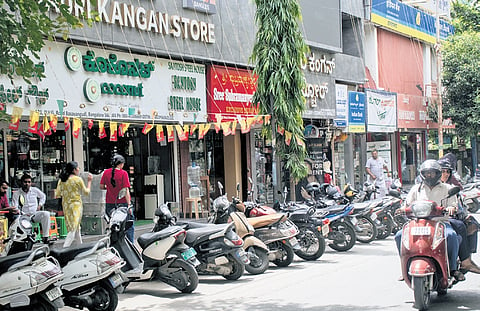

BENGALURU: While businesses are attracted to residential areas by lower rentals than in commercial zones, experts say the root of the problem lies in poor urban governance and a lack of planning. They say the existing planning framework, including the Revised Master Plan (RMP) 2015, provides the basic framework, although compliance and enforcement have often been nonexistent.
Sandeep Anirudhan, Convenor, Citizens’ Agenda for Bengaluru, said, “Commercialisation of residential areas has become a major urban planning and quality-of-life concern in Bengaluru. Residential properties are increasingly being converted into offices, shops, restaurants, schools, paying guest slums, and other commercial establishments. Uncontrolled commercialisation has adversely affected residential neighbourhoods and their livability.”
He said that the problem has its roots in inadequate planning. “Despite the constitutional mandate under the 74th Amendment, governments have failed to establish and empower a functional Metropolitan Planning Committee (MPC) for expert-led,participatory, bottom-up planning.”
He said that, as a result, the city continues to rely on outdated planning frameworks that have failed to meet the city’s growing commercial space needs adequately.
Anirudhan said that the failure to create an autonomous, elected, devolved, and unified city government (mandated in the 74th CAA) has further weakened governance.“Fragmented institutions have left Bengaluru without clear leadership, strategic direction,or accountability. Officials are never held responsible for regulatory failures due to weak oversight, lax administration, and the absence of meaningful consequences for dereliction of duty,” he said.
He said that due to the high volumes of customer traffic, deliveries, and employee commuting, leading to congestion, parking shortages,noise, pollution, increased waste generation, and strain on water, sewerage, and power infrastructure,the residential areas are literally reduced to slums. He added that enforcement remains one of the weakest links, and the oversight, if any, is largely complaint-driven; inspections are infrequent, and multiple agencies share responsibility without any single authority ensuring compliance.
“This fragmented approach creates delays, regulatory gaps, and opportunities for violations to continue unchecked. Penalties are often inadequate, while legal proceedings can take years, allowing unauthorised commercial activities to remain operational,” Anirudhan said.
Members of North East Residents Welfare Association (NERWA) said what could have been addressed early-during construction, inspections, or modifications-has now escalated into a complex, multi-agency challenge.
“Enforcement failure at the ward level, by officials such as Assistant Engineers (AE), Assistant Executive Engineers (AEE), and Executive Engineers (EE), could have prevented much of this. Instead, inaction or selective enforcement has allowed violations to proliferate”, NERWA members said.
They said that residents have not remained silent and have filed numerous complaints with ward offices, health departments, and senior officials, including the Joint Commissioner, Commissioner, and Chief Commissioner of Greater Bengaluru Authority (GBA) and yet the responses to the complaints have largely been limited to issuing notices-often perceived as symbolic gestures rather than genuine attempts at enforcement.
They lamented that the unchecked zoning violations have diminished the quality of life for thousands of residents, which the Supreme Court has repeatedly reminded and warned about. Residents said that a strong nexus exists between the business establishments, politicians and officials, whose hands are allegedly greased to overlook violations.
Sharing his views on the solutions to the problem, Anirudhan said, “The solution lies in implementing the constitutional vision of metropolitan planning and local self-governance, updating land-use plans, creating adequate commercial zones, strengthening enforcement, and ensuring accountability. Commercial growth should be directed to planned corridors and transit-oriented zones, balancing economic growth with the protection of residential neighbourhoods.”
City-centric Bengaluru Nava Nirmana Party (BNP) Founder Srikanth Narasimhan said that the starting point of governance and development is planning.
“Unfortunately, in Bengaluru, the planning process has been mired in bureaucracy and a lack of accountability or ownership. It is still unclear as to which is the true planning authority - is it the Corporation (as mandated in Schedule XII of the Indian Constitution), is it the Greater Bengaluru Authority, is it the Bengaluru Development Authority, is it the state government, or is it someone else? The lack of accountability has manifested itself clearly in the botched-up Revised Master Plans (RMP) of 2015 and 2031”, he said.
Narasimhan said that “The most important step to determine which zones are commercial, which are residential and which are mixed-use, is to articulate the same in the RMP. Given that this itself has not been done properly, it creates a cascading effect where the subsequent implementation is mired in confusion and lack of clarity.”
He said that even if planning was botched, a proper process for approvals, implementation and monitoring could have salvaged the situation to some extent and lamented that, unfortunately, things have gone from bad to worse. “The system is riddled with corruption, lack of monitoring, lack of elected local government to penalise local violators and so on”, he said adding that a combination of the above has resulted in the rampant commercialisation of residential spaces, specifically in areas like Indira Nagar, which has resulted in local citizens having had to fight these battles, often faced with threats and intimidation, to maintain a peaceful living for themselves.
“It is high time that the Corporations are given the complete empowerment to develop the master plans for the city (as mandated in Schedule XII), which in turn, can develop a comprehensive plan along with having the power and authority to implement the same. This will also ensure that the Corporation / Mayor / elected Corporators can be held responsible and accountable for the same, which in turn, will force good governance”, Narasimhan said.
