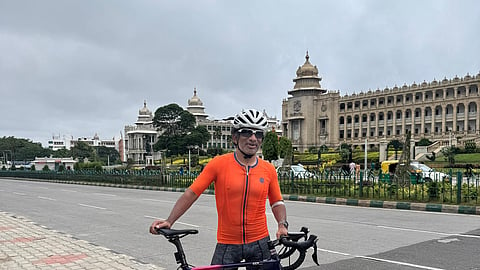

A ride that stretches for 200km or more, continues through the night and often ends after little sleep is no longer a niche pursuit in India. Ultracycling, once confined to a small community of endurance enthusiasts, is steadily drawing more riders in the city, who see it as a test of resilience.
Unlike conventional cycling disciplines where speed is the focus, ultracycling is about sustaining effort over hundreds or even thousands of kilometres while dealing with fatigue, unpredictable weather and mechanical issues. “Some events last for days, not hours. Sleep deprivation, overuse injuries, and saddle discomfort pose major challenges,” says Venkatesh Shivarama, founder, Wheel Sports, who has competed in cycling events ranging from 200m to a 2,000km ride at ISAN Thailand.

Grinshina Kartik, an engineer turned ultracyclist whose longest expedition has been a 3,150km ride from west to east India, believes the biggest battle is mental. “There will be periods of extreme discomfort, pain and hallucination due to sleep deprivation. Those times you have to fight the demons to quit or embrace it and find out what you can really become,” she observes. Kartik has also finished as the top Indian woman at events like the Paris-Brest-Paris 1,200 km, Jog Falls 1,000km and ISAN Thailand 2,000km twice.
Professional cyclist and sales & marketing head Hardik Rai agrees, as he explains, “Ultracycling is a mental game more than physical because doing more than 100km and managing nutrition is not easy,” adding that the growing number of long-distance events has given newcomers an accessible pathway into the sport before they progress to demanding races.
The sport has gradually gained popularity in India over the last few years. Riders attribute this to growing cycling communities, easier access to world-class equipment, visibility on social media, while stressing the stronger focus on fitness post-pandemic. “Many look at ultracycling events like brevets or endurance races as a personal achievement of fitness,” says Shivarama. Brevets, which require riders to compete 200km, 300km, 400km or 600km within a fixed time, have become the first step for many aspiring ultracyclists. Technology has also transformed training. GPS devices, cycling computers and performance tracking platforms allow riders to analyse data, monitor progress and prepare for endurance events with greater precision.
Explaining what goes into prepping when it comes to ultracycling, Kartik says, “You need to embrace taking on maximum calories from carbs, which traditionally people are told to reduce. Mentally, it’s about creating a resolve so strong that unfamiliar foods and surroundings can’t intimidate you. If not in your best physical fitness, you can’t venture into the demanding lifestyle of ultracyclists.”
Technology has also transformed training, with GPS devices, cycling computers and performance tracking platforms allowing riders to monitor progress and prepare for bigger endurance events. Despite this, ultracycling continues to face hurdles. Poor road conditions, potholes, the lack of dedicated cycling lanes, extreme summer temperatures, monsoon rains and limited repair facilities in remote areas are some of the issues, while night rides are further complicated by high beam headlights and poor lane discipline.
Despite the growth, ultracycling continues to face several hurdles. Poor road conditions, potholes, the lack of dedicated cycling lanes, extreme summer temperatures, monsoon rains and limited repair facilities in remote areas continue to be major concerns, while night rides are further complicated by high beam headlights and poor lane discipline. For women, safety remains one of the biggest barriers. “Whenever I have to ride alone at night, I have to think a hundred times before heading out. But my passion for cycling keeps me going despite these challenges,” says Megha Jain, a cyclist who has completed rides from Kashmir to Kanyakumari, Delhi to Nepal and Delhi To Mumbai.
Jain believes more women will take up ultracycling if safety concerns are addressed. “If we can provide safer riding environments, stronger support systems, prompt action when incidents occur and more encouragement families and the cycling community, many more women will feel confident enough to take up ultracycling,” she adds. Karthik agrees, stating that increasing the number of women on the road is the best way to break stereotypes. "Objectively, one of the biggest things that the government can provide is clean bathrooms along highways," she adds.
The sport is also becoming increasingly inclusive, attracting riders from across all age groups and experience levels. According to Shivarama, participants range from mid-20s to 70s, while many achieve their peak endurance in their 40s and 50s after years of consistent training. While concern over theft of cycles and valuables remain, Rai also points out that many newcomers struggle with transporting bicycles by bus, train or flight.