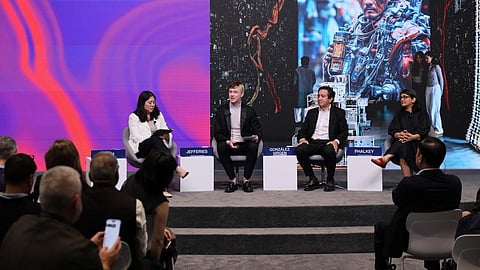

Over 1,500 business leaders and innovators from around the world gathered at the port city of Dalian, China, for the World Economic Forum’s Annual Meeting for the New Champions. Also known as Summer Davos, the event saw the participation of Science Gallery Bengaluru’s director, Jahnavi Phalkey, who took the stage for a panel discussion with directors from other cities in the Science Gallery network – Melbourne and Monterrey.
Although Phalkey has been a part of the forum of experts before, this was her first time speaking on a panel. “I wanted to address the question, ‘how do we turn experiments into experiences, especially for those who are not scientists themselves?’,” she explains, pointing to three that the gallery has featured. “One was an experiment on carbon black, another on experiment on the origins of life (Jivanu), and the third, Foresta Inclusive, was about sensing the hidden life of trees – we had a tree on our premises that was monitored over time, and we did data visualisation for that [tracking particulate matter in the air, wind speed, carbon dioxide levels, light and more],” she shares.

The other question she explored was how to turn people’s curiosity into action, which the gallery does through dedicated labs where people can experience science in a way school often does not allow. “The public lab complex with five laboratories is a new idea which is unique to the Bengaluru gallery. We are hoping our audience members will create their own experiments and take that research out into the public domain. We want to encourage open-ended experiments, because in India, if you don’t clear a particular exam with a particular grade, you are basically not allowed to pursue science. That is a tragedy because we are losing a lot of talent.” With the theme of the event being ‘Innovating at Scale’, Phalkey added how the work done at the Science Gallery can be scaled, with plans for ‘lab in a box’ activities that can bring experiments home.
Along with the panel was an exhibition where dignitaries could explore some of the galleries’ previous exhibits curated to show the intersection of AI and art.
One featured work by an Austrian artist was a robot which measured electrical signals in the brain on a wearable device; another was a mirror which generated poetry based on the emotion it gauged on the user’s face, and yet another was work by researchers in Mexico who had experimented with sounds helping heal bleached coral reefs.
One lighthearted addition, though, caught the most attention, shares Phalkey: “With 2026 being the year of the horse, our horse exhibit became very popular! It is a horse which tries to guess the number you have in your head; of course, it gets it wrong most of the time, but it was a fun element.”
With the gallery set to open two new exhibits ‘quantum’ this August and ‘intelligence’ the next, Phalkey shares that being at the event was a great learning opportunity, saying, “I’m certain we would be doing ‘intelligence’ in a different way if I had not met the other people here today – what events like this do is enrich our understanding of technology, geopolitics and the political economy, which is crucial. I’m humbled and really touched by how people think what we’re doing is relevant.”