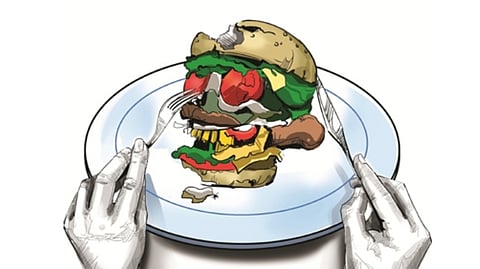

BENGALURU: Karnataka’s proposal to ban the sale of junk food in school and hospital canteens has been welcomed by public health experts, who said it could help tackle the growing prevalence of obesity, diabetes and other non-communicable diseases (NCDs). However, they cautioned that the move must be accompanied by strong regulations, nutrition education and effective enforcement to bring about lasting changes in eating habits.
The proposal, announced by Health and Family Welfare Minister U T Khader, seeks to ensure that only healthy food is sold in school and hospital canteens while also restricting the sale of junk food around schools catering to students up to Class 10.
Dr Upendra Bhojani, lead of Centre for Commercial Determinants of Health, Institute of Public Health (IPH), said children’s food choices are shaped largely by the environments they grow up in rather than by individual decisions alone. “We often call these ‘lifestyle diseases’, but that is a misnomer because it puts the responsibility entirely on individuals. Children’s eating habits are influenced by aggressive food marketing and the larger food environment,” he said.
He said schools are among the most important settings for public health interventions as children spend a significant part of their day there and often consume multiple meals on campus. Restricting foods high in fat, salt and sugar (HFSS) in such settings can encourage healthier eating habits. However, Bhojani said banning junk food in schools and hospitals alone would have limited impact.
“This should be one intervention among many. We also need nutrition education, front-of-pack warning labels, stronger regulation of food advertising targeting children and broader public awareness campaigns,” he said.
Surgical oncologist Dr Vishal Rao described the proposal as a welcome step towards preventive healthcare. “Healthcare should not only focus on treating diseases but also on preventing them. Awareness alone is not enough; every public health policy requires effective enforcement,” he said.
Rao said reducing junk food consumption is crucial from a cancer prevention perspective because obesity is a recognised risk factor for several cancers. He also highlighted the rising burden of diabetes, hypertension and childhood obesity.
Experts said restricting unhealthy food in schools and hospitals would not eliminate unhealthy eating overnight but would create healthier food environments where nutritious choices become easier. They stressed that the policy should be complemented by sustained awareness campaigns, better food labelling and stronger regulation of unhealthy food marketing to ensure meaningful long-term public health outcomes.
