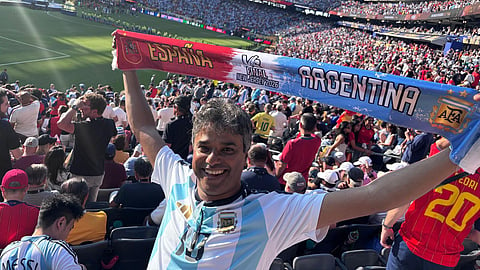

Thirty-nine days of football ended on July 19 at New York New Jersey Stadium. When the final whistle blew, football once again became the story. It usually does. Would you board a six-hour red-eye flight without a ticket for the World Cup final? Most people wouldn’t. I did. Watching what could be Lionel Messi’s final World Cup match felt worth the risk. Average ticket prices had climbed to almost $11,000 (over `10 lakh). A friend assured me we would find something once we reached New York.
The semifinal against England had already convinced me that I was watching the greatest footballer. That was enough to get me on a plane. When I landed, we still had no tickets. By late morning, after hours of anxious searching, we bought two seats following a price drop. Now there was only one wish left. Let Messi write one more chapter.
Inside the stadium, 80,663 people waited. The Argentine supporters never stopped singing; the Spanish supporters looked calmer. Then came halftime. As Wayne Rooney summed it up, “I like many of those artists, but I thought it was crap.” There were guest appearances and elaborate choreography. I found myself wondering what Ronaldo, Ronaldinho and Madonna were doing together. I wondered why football suddenly needed to become something else. It was America’s version of the Super Bowl.
The result was filled with questions. What if Argentina had won? What if Messi had scored? What if this really was the fairy-tale ending everyone wanted? Football, however, has very little interest in fairy tales. It rewards habits. Spain were simply better. They looked like a team that had been learning together since childhood. Spain passed. Argentina chased. Spain pressed. Argentina reacted. For long periods, Messi watched the game instead of shaping it.
Eight Barcelona players were part of Spain’s World Cup-winning squad. Substitute Ferran Torres scored with a composed left-footed finish. It felt deserved. Captain Rodri lifted the Golden Ball. That felt deserved too (Messi fans may disagree). Argentina never looked like role models. There was too much cynicism, kicking, complaining and too little football. The ugly scenes after the match only reinforced that feeling. Punches were thrown, tempers exploded. It was a disappointing end to a disappointing performance by Argentina. Messi walked away without the trophy. His last dance ended in tears. Yet legacies are never built on one evening.
Perhaps my favourite image of this World Cup was not from the final itself. Years ago, there was a photograph of Messi gently bathing a baby named Lamine Yamal. After the final, seeing them embrace carried a different meaning.
My relationship with football began in Kharagpur, West Bengal. We often played with a ball made from old newspapers wrapped tightly with rubber bands. Football was never about the ball; it was about friendship and learning to lose. I played for my school, and later for my district. I still remember missing a penalty in a knockout match. Strangely, we remember our failures longer than our victories. Life moved on. Football stayed. At SAP, I played again. I travelled to Germany. I experienced the 2006 World Cup while living in Heidelberg. Years later, America became home, and football slowly gave way to tennis. Then Messi arrived in Miami. One player accelerated the growth of an entire sport in a country. Few athletes have changed culture the way Messi did. As I walked out of the stadium that night, surrounded by thousands of supporters heading home, one thought stayed with me. Spain did not win because they had the best individual player; they won because they were the best team. It is certainly one of the oldest lessons in life. Share, trust, move together, as there is only one ball and no one wins alone.
