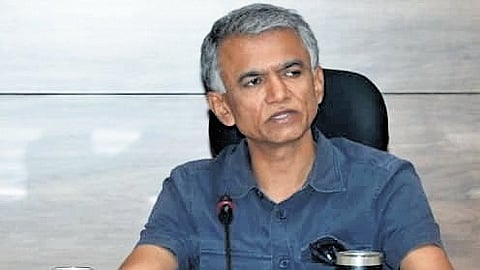

BENGALURU: Greater Bengaluru Development Minister Krishna Byre Gowda on Saturday said he has directed the Bangalore Metro Rail Corporation Limited (BMRCL) to begin the trial run of the Namma Metro Blue Line in October and begin commercial operation in 2027.
He said this during a meeting with stakeholders of a 17-km stretch of the Outer Ring Road (ORR) on Saturday. The actual deadline for the completion of the project connecting KR Puram to Central Silk Board, Hennur, Hebbal and up to the airport in different phases covering 58.19 km was 2024.
Gowda told the affected residents that the government is serious about the redevelopment of the ORR stretch with a fund of Rs 450 crore. He said the government has invited suggestions from the public even after the design was submitted by consultants because the project is a big challenge.
“We will share a design draft with you, and we will also take your suggestion, and if it fits, we will integrate and take it ahead,” said the minister. He said the Metro is the only transit option to manage the traffic. “On these stretches, traffic volume, junction complexity and complex directional movement pose a challenge. Hence Metro is top-priority,” he said.
Gowda said people fail to surrender the land margin according to the master plan because of mushrooming of unauthorised layouts, construction of multistorey homes on 20-feet roads and formation of layouts without considering space for civic amenities and playgrounds, which have compounded the problem in the last 30 years. He said there should be a new approach and redevelopment of this stretch.
About the challenges, he said suggestions such as a grade separator are too costly and issues complicating land acquisition prevail. “Due to the complex intersection movement, traffic is a problem, and it is a challenge in rationalising the junction.
Secondly, the consistency of the footpath is not adequate. People who usually would walk for 2km are forced to choose motorised mobility. If the issue is fixed, the situation can be improved,” he said, adding that for the past 15 days he had been on night rounds on this stretch with officials to find solutions.
What’s in new draft design
Constructing at least 10 feet wide well-paved and durable granite footpaths
High-rise pedestrian crossings and footover bridges designed to reach cycle tracks and bus bays, remodelled junctions and upgraded skywalks
Annuity Payment model to maintain road quality. According to this, the contractors themselves will have to bear the responsibility of road maintenance for the next 10 to 12 years
The government will pay them in installments after checking the quality of the road surface, lights and footpath every year
Asphalt or white topping on major carriageways – white topping will ensure the road lasts for about 25 years
Stormwater drainage, drinking water, sewage and electricity and gas pipelines to be carried out with inter-departmental coordination
Construction of public toilets, parking and other civic amenities, such as parking system, bus stands and pedestrian facilities
