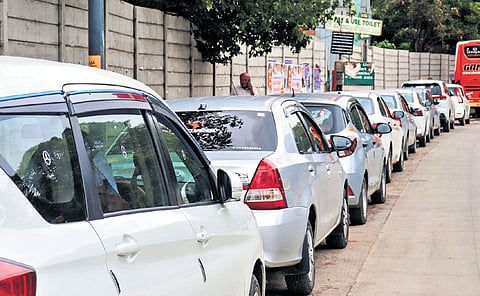

BENGALURU: Seshadri Road, surrounded by educational institutions and commercial establishments and frequented by people from all walks of life, is slowly emerging as a yellow spot, with multiple civic issues taking root. Footpaths with gaping holes, illegal parking and public urination along the stretch highlight failures across all three pillars of civic responsibility – the corporation, enforcement agencies and citizens.
The stretch, surrounded by Maharani Cluster University, CMS Business School, Race Course, Freedom Park and several commercial streets, is a busy arterial road. People, particularly students, use it daily, navigating damaged and unclean footpaths while contending with roads narrowed by the illegal parking of vehicles.
CIVIC-Bangalore executive trustee Kathyayini Chamaraj said, “The root cause of such issues, in general, is a lack of coordination. Ward-level committees and Area Sabhas in urban spaces not being empowered to take independent decisions.”
She said local bodies in Bengaluru are not equipped to discharge the 18 core municipal functions under the Twelfth Schedule of the 74th Constitutional Amendment Act. She said strengthening governing bodies is key to prevent civic issues from escalating in an area.
Referring to Seshadri Road’s gradual emergence as a yellow spot despite the presence of a pay-and-use toilet within 50 metres of the location, people who visit the area for various works regularly say that increasing the number of free-to-use toilets may help tackle the issue.
Swachh Survekshan expert V Ramprasad differed. “Health inspectors and the chief marshal must take accountability if an area emerges as a yellow spot. And if payment at public toilets is the issue, a proven solution is to introduce a monthly pass system. That way, the fee remains nominal, toilet managers receive a steady income.”
A GBA official said, “The traffic police should work hand in hand to solve illegal parking. Public urination will end only with a change in people’s mentality towards cleanliness.”
