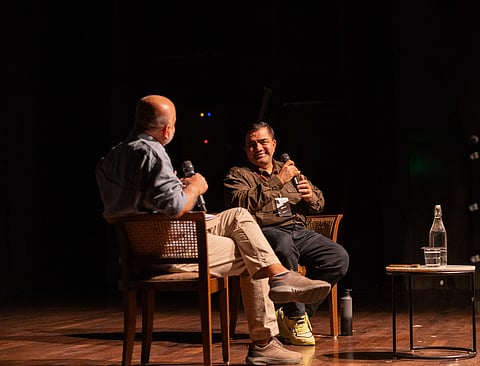

For decades, Mumbai’s underworld has occupied a curious space in public imagination: a world of gang wars, power struggles, police crackdowns and larger-than-life figures whose stories often blurred the line between reality and fiction. Few writers have documented that landscape as closely as author S Hussain Zaidi, whose works have chronicled organised crime and some of its most notorious names.
Dead Write, a recent genre festival by the Bangalore Literature Festival, that brought together voices exploring crime and storytelling, saw Zaidi among its speakers. Talking to CE on the sidelines of the event, the author said his journey into crime journalism had little to do with ambition and more to do with circumstances. “I became a crime journalist by accident. When I applied [for the job], there was no vacancy for civic reporting, or education or politics. The only slot vacant was for crime journalism, and I wanted to become a reporter, so I thought, why not try my hand, maybe I can do this,” he recalls.
The unexpected career-turn led him into decades of reporting on gangsters and underworld networks, experiences that later found their way into several of his books. Looking back at the underworld today, Zaidi reveals the landscape has changed drastically. He says, “These days they are not violent or abusive. They don’t call or threaten too many people. The manpower they have is much less and new recruitment has stopped. So they are in a way crippled by the police crackdown”

Some of his most memorable encounters came from unexpected people. He recalls meeting a wealthy man whom he initially assumed was a hotelier, before learning that he had quietly been working as an informer. Speaking about it, Zaidi says, “I asked him, ‘why are you an informer and how have you made this money?’
He said, ‘I’m just trying to help the police so that it could be my contribution towards eradicating crime from this city. Because I’m in this business, a lot
of people come to my bar and talk. Sometimes I record their conversations or get them on CCTV and share it with the police.” The discovery surprised him because the man appeared to have no obvious personal motivation behind his actions.
No conversation around Mumbai’s underworld remains complete without the mention of Dawood Ibrahim, a figure who occupies a significant place in several of Zaidi’s works. Asked whether the wanted underworld don is still alive, he replies, “Yeah, he is, and having fun,” adding that he was believed to be near Karachi. But rather than adding to the ‘mythology’ surrounding him, Zaidi questions why people had elevated him into something larger than reality. “He’s but a human being, a mortal, a gangster. You cannot elevate him to that level. But it is movies that have made him so big. Even he must be laughing at us and saying, ‘Oh wow, you guys, thank you for making me so big’,” he laughs.
The 58-year-old author of Dongri To Dubai: Six Decades of the Mumbai Mafia, Mafia Queens of Mumbai and Black Friday: The True Story of the Bombay Bomb Blasts, also challenges common assumptions around Dawood’s rise. “They always thought that Dawood became a criminal much later in life or by his own efforts. But actually, he was a small-time ruffian, who was used by Inspector Ranbeer Likha to handle the Pathans in those days,” he shares. According to him, rivalries and power structures also played a role in Dawood’s early rise, with the Pathans’ growing influence creating circumstances that helped propel him forward and a don was born, officially.
Zaidi’s exploration of the underworld also extended beyond gangsters through Mafia Queens of Mumbai, where he focused on women and their role within that burning world. Speaking about what interested him in those stories, he says, “Women are far more interesting. They are lethal, manipulative and can make men dance
to their tunes. Men don’t even realise and understand that this ‘poor, harmless-looking girl’ is actually ruling him and making him do
so many impossible things. So, I thought that Mafia Queens should be an experiment.” Even after writing about them, Zaidi says he continues to be fascinated by the profiles of these women.