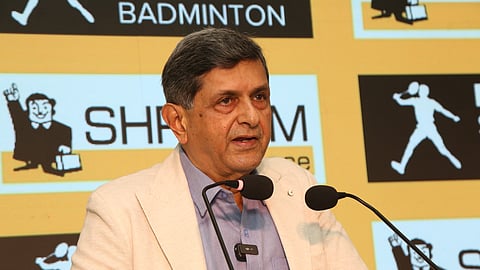

For decades, badminton coaching has been built on the experience, intuition and keen observation of coaches who guided players through every aspect of the game. However, the sport now stands at the threshold of a technological revolution. Legendary badminton player and former World No. 1 Prakash Padukone believes that Artificial Intelligence (AI) has the potential to transform the way badminton is taught.
Padukone has begun incorporating AI into badminton training. By utilising tools such as video analytics, motion tracking, and performance data analysis, AI can provide detailed insights into a player’s technique, movement patterns, decision-making and performance. “We are video recording matches post which a 3D version is generated which give us the map. We analyse the way the player holds the racquet, their footwork, stability around the court,” he says, adding, “We are in discussion with a few tech companies who are keen to support us in expanding this initiative.”
A key observation Padukone has made is that many parents are eager to follow their children’s progress on court, but it is often difficult for them to be physically present during training sessions. “We plan to record the sessions, review the footage and then share those videos with parents,” he explains. “It will give them a clearer understanding of how their children are performing and areas of improvement.”
He also adds that the academy plans to share the collected training data with technology partners for analysis. Within two days, a detailed report will be sent back to the academy, which will allow the coaches to assess players’ performance accurately and provide targeted guidance based on the insights. In some cases, the data could reveal gaps in coaching methods as well. “If we notice the same mistakes repeated by 30-40 students, it will indicate a need to improve the coaching style,” he says.
AI can also analyse wrist work, a key element in badminton. “Wrist work varies player to player. We have noticed many students often struggle with this. Once the session gets over, we show them the way they played and the result we obtained from AI. That will give them a clear picture of what needs to be done. Then, with the guidance, we try to solve the problems within a specific timeframe,” says the first Indian to win the All England Open in 1980.
