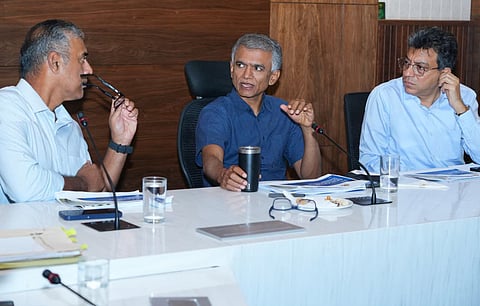

BENGALURU: Is filling potholes rocket science? Can’t we build roads without potholes? Why do newly laid roads develop potholes? These were the questions raised by Bengaluru Development Minister Krishna Byre Gowda to Greater Bengaluru Authority (GBA) engineers in his maiden meeting on Tuesday. He also raised concerns over the exclusion of Bengaluru Development Authority (BDA) and Bengaluru Metropolitan Region Development Authority (BMRDA) from his portfolio.
Ridiculing the pothole-filling exercise, the minister remarked that while the old potholes were filled, new ones were emerging like mushrooms after each rain. He sought to know from the engineers the problems in building quality roads without potholes. “I understand that a few works are difficult, but these (pothole filling) are basic works. Is building quality roads more difficult than rocket science?” Gowda asked. He said Bengaluru has earned a bad reputation as a “pothole city”.
Gowda said the neighbouring states have better roads despite receiving heavy rainfall. “If their roads can be free from potholes, why can’t ours be the same?” he questioned. He told the officials and engineers that if the work is done properly, it would solve many problems. Later, the minister told the media that his priority is to improve the quality of life of 1.5 crore residents of Bengaluru and make it a liveable city by bringing in administrative reforms in the GBA and the five city corporations under it. He said his priority would be to address problems faced by citizens every day.
Gowda said, “While we always talk of making Bengaluru a world-class city, work must also be done to improve the lives of its residents.”
Gowda said people’s cooperation is essential to address the garbage problem effectively. Responding to allegations by the Opposition that the Integrated Solid Waste Management tenders were given to a blacklisted company with inflated rates, he said the government has set up a tender evaluation committee comprising senior officials, and a final call would be taken based on its report.
The minister also said that if the Opposition has any concern, it is free to submit its complaints either to the committee or directly to him. Replying to questions on the allegations of the tender period fixed for 30 years, he defended the move, stating that cities like Bengaluru need long-term planning. He said the city’s present challenges were a result of the short-term approaches in the past.
Gowda also said Karnataka’s e-khata system was the best in India, but admitted there were some problems in the system and that it would be addressed.
With the West Asia crisis lasting for several months, the bitumen is now being diverted to fertilizer on priority. As a result, a shortage of between 150 to 200 tonnes is reported in each of five city corporations under the Greater Bengaluru Authority (GBA). The primary concern among the engineers is approaching monsoon and most of the roads under the blacktopping project remaining incomplete, GBA officials told Bengaluru Development Minister Krishna Byre Gowda and sought his intervention on Tuesday.
A senior official at the urban development department said each city corporation has a demand of around 1,000 tonnes of bitumen for annual road maintenance and had placed orders for around 200 tonnes two months ago. The bitumen supply is hit, they said. Bitumen is used to coat granules of urea. It prevents the quick dissolution of urea in the soil, supporting plant growth. Last month, the contractors expressed concern over a price hike from Rs 44,000 per tonne of bitumen to Rs 92,000 due to the Iran-Israel and US war.
