
There is something quite unsettling about the idea of forgery in books. A book, after all, is a vessel of trust. Between its covers lies an implicit contract between the author and the reader. To tamper with that trust feels, in some ways, a more personal betrayal than with other forms of forgery.
I was reminded of this not long ago, when my editor took me to a bookstore to sign copies of my newly-released Shelf Aware. The staff appeared wary, though polite. My editor, it turned out, had not informed them of our visit. They were unsure if I was, in fact, the author.
Their caution was not without reason. A few months earlier, an imposter had walked into the same store and convincingly signed hundreds of copies of a book, only for the staff to discover later that he was not the author. No profit motive, just a prank. The bookstore owner, understandably, responded with a firm rule: no unannounced authors, no exceptions.
Why do people forge? Is it the lure of money, or the thrill of deception? Or is it some strange desire to blur the line between the authentic and the imagined?
I had an encounter with forgery when I came across what seemed like a rare, signed trilogy America in the King Years by Taylor Branch, offered at a surprisingly reasonable price. I unhesitatingly placed the order. The book, naturally, never arrived. The entire website was a carefully constructed illusion. The world of signed books, especially in online marketplaces, operates in a delicate balance between trust and skepticism. Platforms like eBay have made rare books more accessible than ever before. But without credible third-party authentication from organisations such as PSA, JSA, or Beckett Authentication Services, the probability of a signature being genuine diminishes significantly.
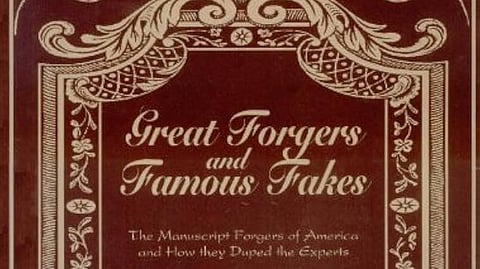
In this uncertain landscape, the work of scholars and experts becomes invaluable. Charles Hamilton Jr, a noted handwriting expert, devoted much of his career to studying and exposing forgeries. His books, such as Great Forgers and Famous Fakes and A Gentleman’s Guide to Forgery, offer a fascinating glimpse into the minds and methods of those who deceive. Reading someone who understands the craft so intimately makes us feel we’re being let in on a secret we’re not entirely comfortable knowing. Literature, unsurprisingly, has long been drawn to this theme.
In The Forger’s Spell, Edward Dolnick recounts the story of Konrad Kujau, the man behind the infamous Hitler Diaries, a deception so audacious it fooled historians and journalists alike. What makes the story compelling is not just the act of forgery, but the willingness of people to believe in it. In The Man Who Loved Books Too Much, Allison Hoover Bartlett explores a different but related obsession — the thin line between love and possession in the world of rare books. I had the privilege of speaking with her at length about this work, and what stayed with me was not the crime, but the psychology behind it.
Similarly, The Map Thief by Michael Blanding delves into the world of rare maps and the desperation that drives individuals to steal and alter history itself. Thomas Mallon, in Forging History, examines literary forgeries across time, while David R. Henige, in Faking Literature, offers a more academic but deeply unsettling reminder of how easily false texts can slip into accepted canon. Even fiction, like The Forgery of Venus by Michael Gruber, circles back to the same enduring questions of authorship, originality, and authenticity.
Perhaps that is what makes book forgery so compelling. It is not just about deception. It is about belief.
A forged signature only has power if someone is willing to accept it as real. In that sense, every forgery is a collaboration – between the forger and the believer. And maybe, in some secret corner of our winds, we are all willing participants.
(The writer’s views are personal)
