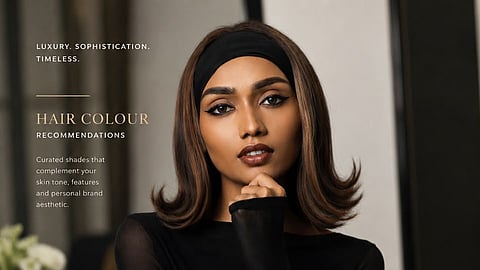

A mini life crisis or a sudden urge to transform into one’s best version, and the salon chair is often where people end up next. But how many times have you walked in for a haircut and walked out with exactly what you imagined? For many, the gap between expectation and reality has always been part of the experience. Now, that gap is being narrowed at least visually by artificial intelligence. Before stepping into a salon or booking an image consultant, people are turning to AI to preview hairstyles, colours and experiment with versions of themselves. From generating haircut simulations and analysing skincare ingredients to recommending colours that complement skin tone, it is undoubtedly becoming part of modern grooming routine.
Professionals across the grooming and styling industry say the shift has become particularly noticeable over the past year. While clients once arrived with celebrity photos saved from Google, Instagram or Pinterest, many now walk in with AI-generated images tailored to their face and preferences. Danny, senior hairstylist at Rock Paper Scissors, notes this change is now visible across age groups, including senior clients and children. “It has helped us cut short our consultation and given clients the confidence to try different styles, colours and even beard shapes,” he explains, noting that clients now arrive with clearer visual references.

For digital creator Avanthika Babu, AI has become more of a practical grooming assistant, be it her skincare or hair colour recommendations. She uses it not just for styling ideas but also for understanding what goes into the skincare products she uses. “I’ve even uploaded ingredient lists and asked AI for a breakdown before trying a product,” she says on how AI helps her make more informed decisions rather than replacing her judgment, adding, “I’d use it as a guide, not the final decision-maker.”
Danny agrees, as he highlights struggle with realism, when it comes to hair texture. He shares that many clients come to him wanting their hair to look exactly like the AI image, but he has to give them a reality check based on texture, lifestyle and maintenance. “Straight hair is almost a 10 out of 10 match. Wavy hair is around 70 to 80 per cent, but curly hair is closer to 40 to 50 per cent. That’s where our experience comes into play,” he says.
Despite limitations, stylists are also using AI themselves to support consultations, especially for colour exploration. Image consultant Sonia Pardesi sees AI as a strong entry point for clients exploring personal style. It helps quickly map out options and ideas, but she stresses that interpretation still requires human insight. “AI is excellent at generating ideas, visualising different looks and saving time. Those recommendations still need to be interpreted through the lens of personality, profession and comfort level,” she shares.
For her, the emotional dimension of styling cannot be replicated. “Building confidence, reading emotions, understanding aspirations and helping someone express their authentic self requires empathy and human connection, says Pardesi, who strongly believes that AI will enhance the profession rather than replace it. She adds, “It will increase the demand for consultants who can offer strategic thinking, emotional intelligence and a personalised experience.”
Stylist Gousia Galib Khan agrees with this balance between adoption and caution, while noticing a clear rise in clients, especially Gen Zs, arriving with AI-generated inspo. “More clients are using AI as their first point of reference before speaking to a stylist,” she says. But she emphasises that styling remains deeply personal. “Fashion isn’t just about what looks good – it’s about what feels right for the individual. The final styling decisions are always based on my professional judgment, experience and the client’s individuality.” She also incorporates AI into her own workflow, using it for mood boards and creative exploration.
Users are still cautious about AI when giving and taking inputs. “It’s useful for inspiration, but it’s still a tool, not a replacement for personal experience or expert advice,” Babu underlines.