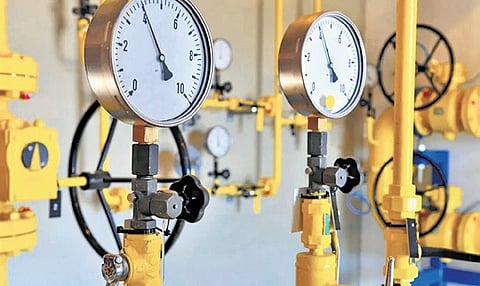

Execution of the piped gasification project for all households in Bengaluru is a challenge and in case of old Bengaluru regions a near impossible task. Citizens will have to wait for a long time to get it.
There are many reasons. Primarily, there is no one consolidated underground infrastructure and utility map for the entire city or even ward-wise. There is also no space available along the sides roads and footpaths in old Bengaluru regions now to dig and lay pipelines. Further, while laying the concrete white-topped roads or even black-topped roads under the Smart City project, no space was left aside for laying the gas pipelines. There is also no space of a minimum of one metre left between footpaths and households and commercial spaces to lay the gas pipelines.
It is a mandate of the Government of India that under the Smart City project, cities should have piped gas utilities. It has been well executed in Mumbai and Delhi but not in Bengaluru. This is despite the Supreme Court and High Courts' directions for Mumbai and Delhi.
According to data from the special desk created in the Urban Development Department, monitored by the Petroleum and Natural Gas Regulatory Board (PNGRB) for carrying out gas City Gas Distribution project in Karnataka, connections have been laid for 5.77 lakh households, but gas is being supplied to 3.5 lakh households. In the case of Bengaluru, infrastructure has been laid for 3.5 lakh households and supply is ongoing for 1.2lakh households.
"We have not been able to lay the pipes for the last mile connectivity to connect the households, thus there is a gap of around 2.5 lakh houses in the City and State. Land acquisition is a major hassle. In Bengaluru, pipes in old areas cannot be laid because of lack of space. In new areas, work is going on. But areas where road works have been completed the mandated gap has not been maintained for the pipelines. There is a lot of redtapism in giving permissions at the level of executive engineers," sources in PNGRB said.
Officials from the Greater Bengaluru Authority (GBA) and Bengaluru Smart Infrastructure Limited (B-SMILE) said, ducts have been created along smart city roads and newly laid roads which can be adequately used for all public utility works. But officials in Gas Authority of India Limited (GAIL), one of the eight listed agencies implementing the piped gas project in Bengaluru, said: "The gas pipelines are made of steel. They cannot be bent and passed through small ducts. Dedicated gas pipelines have to be laid on long stretches as it has been done in City outskirts and other cities. The government has failed to make the adequate provisions."
The PNGRB also noted that work of cross country piped gas project has been delayed. The Kochi-Koottanad-Bengaluru-Mangaluru Pipeline Project (KKBMPL) for unlimited gas supply and under grid has only been 75% completed. While 450Km of Bengaluru to Coimbatore has been completed, Bengaluru to Kerala is yet to be completed. The project has started in 2019.
The Government of India, in public interest, notified in December 2006, the Policy for Development of Natural Gas Pipelines and City or Local Natural Gas Distribution Networks. In Karnataka the project started from 2015 when the first gas agency was authorised for connection and supply. The last agency was authorised in 2022.
The Karnataka state government also mandated that cities and towns' master plans should include the City Gas Distribution network and should have the provision of CNG stations. They should also make necessary provisions to include PNG infrastructure while giving building plan approvals, noted the Karnataka State Policy for the Development of City Gas Distribution Network of 2023. However, many engineers in GBA and five city corporations are not aware of this. "I am not aware of this. It was not discussed in recently held revised master plan project meeting. We will look into it," said a senior GBA engineer.
