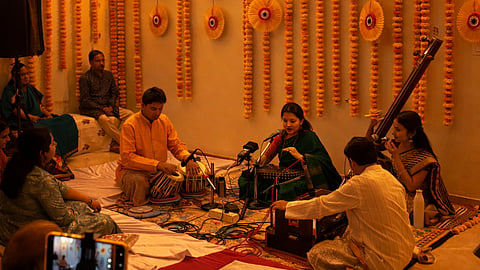

With Ugadi, Gudi Padwa, and Nowruz just behind us, and Eid al-Fitr today, Bengalureans are soaking in the festive atmosphere perfuming the air. Forgoing standing-roomonly gigs and typical kacheris, youngsters are finding their way into the cosy living rooms of classical music enthusiasts where musicians perform for small groups. 10 to 25 people gathered, some on mats, legs folded, sometimes perched on stairs or a sofa’s arm – focussed entirely on each note that leaves the musicians’ lips.
Many of these baithaks are being hosted in areas that don’t see frequent concerts, like Bellandur, Haralur, or, as senior manager Shreejon Biyani’s favourite organisers, Nada Bindu, does – at the homes of whoever volunteers, anywhere in the city. “Concerts, especially in Bengaluru, demand a lot – travel, parking and then the crowd. When you return, you’re exhausted. But this is a serene experience. You find people who are there because of the music they love, not for a star . You hardly see people leaving midway either,” he points out. For artistes like Radhika Kumar, a singer in the band Indofuzon, which has been taking their baithak-inspired concert across the world, the beauty of the format is the intimacy between performer and listener. “The audience becomes a part of me, because they sit close, react to every line and are in complete sync with every hum. It’s not a stage performance where you are being observed; this is a shared experience. We pause between songs, we share personal memories…people want that kind of connection,” she explains
Having grown up in cities like Lucknow and Kolkata, immersed in this intimacy with music, hosts like Ayat’s Vishnupriya Srivastava and Aashore’s Purbani Das started their baithaks as a way to recreate that culture in the city they now call home. “At home (Kolkata), people would practice some sort of art form – play an instrument, sing, write poetry and come together to present their art over food. I didn’t have a circle like that here,” reveals Das. Hoping to encourage this sense of community, Das also serves up a homely meal after concerts. Of course, Karnataka, too, has had a culture of at-home kacheris, but often limited to people in the know – music gurus and families with classical music legacies. With the word about these new baithaks spreading on social media, Chitkala Sharma, who founded Nada Bindu with a group of classical music students, notes, “Chamber-style Carnatic concerts are usually very private, even though free public concerts happen often. The major difference with this being open to everyone is that it opens up conversations, and you get to meet interesting people. Those traditional home concerts were also for the patronage of classical arts – we need to revive it a little.”
Curious young people, often with no background in classical music, end up attending baithaks, which feel more accessible than a typical classical concert. Srivastava took this a step further, curating each show with the aim to break misconceptions about classical music that followers shared. “One impression was that classical music is intimidating because it has too many scales. So I had our performer explain each raag. She improvised the raag, talked about her gharana and taught people how to keep taal (beat) too, so people left with a sense of understanding,” she explains, adding with a smile, “Now, I see people coming back again and again.”
