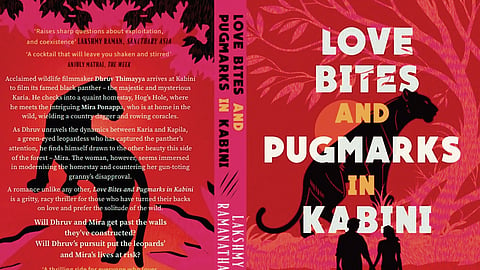

In the fringes of cities like Bengaluru, leopard sightings have increasingly become part of everyday conversation, reminding us that the boundary between human spaces and the wild is thinner than we imagine. It is this uneasy coexistence that city-based writer Lakshmy Ramanathan explores in her novel, Love Bites and Pugmarks in Kabini, blending wildlife conservation with an unlikely thread of romance.
Set against the forests of Kabini, the book traces leopard behaviour alongside a late-in-life love story, drawing from years of observation, research and a deep personal interest in the natural world. “I grew up watching wildlife documentaries. A large part of my childhood was either spent outdoors in nature or in front of the screen watching them,” she says. That interest intensified during the pandemic, when she began not just consuming documentaries but also understanding the effort behind them, as she adds, “ I started watching behind-the-scenes footage – how long people wait for a single sequence. It made me admire the passion and perseverance of wildlife filmmakers.”

By late 2021, she had found her narrative anchor – a wildlife filmmaker as her protagonist. “I realised I could use that as a pivot to talk about conservation issues,” she explains. But her decision to focus on leopards was equally deliberate. “There are so many documentaries about tigers. Leopards are just as fascinating but often overlooked,” she points out. Known for their adaptability, leopards thrive across forests and even near human settlements, making them central to conversations around coexistence.
And choosing Kabini felt like the natural setting, she adds. “As a Bengalurean, it’s our backyard. At the same time, it gained attention following reports of black panther sightings. But conservation is never about one animal – it’s about the entire ecosystem,” she says.
At the heart of the book, she also talks about human-wildlife conflict that has become common these days, stating that shrinking territories as a driver of increased encounters. “When a leopard is injured or loses its prey, it may turn to domestic animals because they are easier targets, and that can escalate conflict,” she points out.
Yet, according to Ramanathan, one of the biggest misconceptions is that leopards are aggressive by nature. “From everything I’ve learned, they want to be left alone. They don’t want to attack humans – they simply want space. We don’t see the world as a shared space, but our territories are bound to intersect.”
Beyond conservation, as the title suggests, the book also explores love beyond youth. The narrative travels with wildlife filmmaker Dhruv Thimayya, who arrives in Kabini to document the elusive black panther, Karia, only to find himself drawn into both the complex dynamics of the wild and an unexpected connection with Mira Ponappa, a fiercely independent woman rooted in the landscape. As he observes the relationship between Karia and the leopardess Kapila, a parallel story of human emotion unfolds. “We often see romance centred on people in their twenties. I wanted to show that you can find love at any age. When you’re older, you have clarity, but you’re also more set in your ways. That can make relationships more complex,” Ramanathan says.