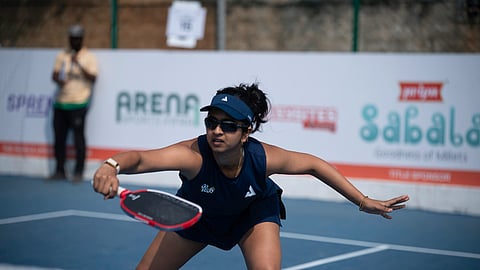

A former pro tennis player who has represented her nation countless times – even winning gold at the South Asian Games at the peak of her career – Sharmada Balu didn’t think much of the first pickleball game she witnessed. But this scepticism quickly turned into curiosity when she picked up the racquet herself for a neighbourhood tournament. “I won the first time I played and I loved competing so much. It was at a time when I’d decided to step back from tennis and was trying to see what else I could do while staying in the sports field. Pickleball fell into my lap at the perfect time,” says the player. She is now set to captain a team at Centre Court Pickleball, Bengaluru’s first franchise-based pickleball league which is ongoing through May.
Transitioning from playing pro-level tennis to pickleball definitely gave her an edge, explains Balu, saying, “The transition is smooth because you’re a lot fitter, quicker, and your strokes are much cleaner but as you start playing at higher levels, it gets tougher. A lot of players in the league are those who have played racquet sports at pro levels before, so the competition is intense.” Some things about pickleball, though, played on a smaller court and with different rules, need more than any deeply embedded tennis instincts, as Balu shares, “You’ve been trained your whole life to hit the ball hard, but here, you need to slow the ball down, stay calm and only attack at certain points. I struggled with this initially.”
Captaining The Rally Renegades, a team of 10 players, Balu is optimistic about their chances, especially with the opening day seeing them win four out of six matches across singles and mixed doubles categories. She says, “We have a great bunch of highly-motivated people in our team and we’re in sync,” she says, adding, “The crowd of around 1,200 people who had turned up to watch us play made it so much better as well. The community around the sport is lovely in Bengaluru and the league has definitely elevated the pickleball scene here.”

While pickleball may have become immensely popular in India over the last two years with neighbourhood groups, local competitions and tournaments popping up all over – nothing could have prepared Anup Basti for the English Pickleball open – a tournament that saw 2,500 competitors from around the world. “Under one roof, there were matches happening simultaneously at 60 courts, across age categories – the scale was huge,” recalls Basti, who went on to win gold in the singles category despite signing up impulsively on the suggestion of a friend. “It was a life-changing experience, because playing international tournaments is not easy, especially when you’re not a trained player. Whatever skills I’ve learned is just by practising, watching videos and my table tennis background,” says the former state-level table tennis player.
How do Indian players show up today, on the international pickleball stage with an edge? “The quality of the players from India is really good because of our culture of racquet sports. But there are a lot of unorthodox players who come from football or other sports backgrounds, some are rude and scream too, you need to adapt quickly and figure out how to play against them. Pickleball is a mental game too and Indian players just don’t quit as easily as others. We consider ourselves maybe underdogs and want to prove a point,” he says.
At home too, there is clearly a point to be proven as Basti’s team, Rally Renegades, gave it their all. The franchise system, Basti says, is good news for players who want to go beyond apartment pickleball courts and play professionally as all players are paid to play, unlike in tournaments which usually reward winners with cash prizes. “It’s a huge commitment to play every Saturday and put aside several hours for training during the week, especially since many have full-time jobs. Because of this, I missed playing in other (unpaid) leagues. It’s amazing that players get paid now, from a base price of `10,000 to getting auctioned for up to `1,50,000. Even more crucial is the fact that we are getting access to resources like trainers and physical therapists.”