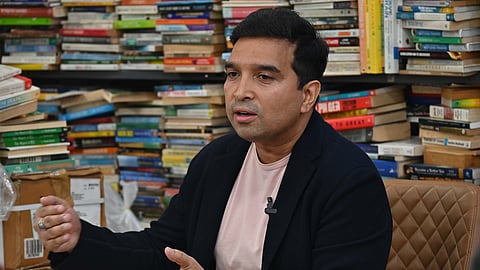

The floodlights were blinding, the roar of a zillion voices echoing across the stadium and the tension was a physical weight. But inside the mind of the man at the crease, there was only a pulsing silence. This isn’t a scene from a high-stakes match – it is the fundamental frequency of advocate Karthikeya Vajpai’s new book, The Unbecoming (Penguin, `399). Vajpai, who transitioned from a passionate cricketer who represented his state at the U14 nationals to a writer, argues that our greatest victories happen long before we step into the field.
Most of the world is obsessed with becoming – stacking up titles and identities like trophies on a shelf. Vajpai says that this is exactly where we trip up, as our labels eventually become our cages. “There is nothing wrong with becoming, but the problem happens when we identify with what we want to become, when it becomes a part of our identity. Our strengths and weaknesses come through that identity, which limits us from taking any shape,” he notes.
The Unbecoming isn’t about losing one’s ambition but about stripping away the past lenses that blur the present. In his view, if one doesn’t tether their soul to a single role, they gain the freedom to write many chapters of becoming without getting stuck in any of them.
Using cricket as a backdrop for spirituality might seem unconventional, but for Vajpai, the pitch is the ultimate classroom for the flow state. “In cricket, when you face a ball which is 140km at a speed coming towards you, you have 0.33 seconds to react. You have to be your spontaneous best. It teaches you how to engage with the present moment. I merged these two schools to explain what this state of flow actually requires,” he explains.
The book follows Siddharth, a decorated cricketer who, despite his legacy, finds himself lost. Through it, Vajpai suggests that success fails us when we become the doer. When we believe we are the sole authors of our triumphs, we become equally shackled by our failures. “Bad form is similar to writer’s block. It’s being too attached to something that has worked for you in the past and not allowing a fresh perspective to seep into the situation. Once you shed those past attachments, you can return to form,” he says.
Proud Nod
The Unbecoming’s journey is punctuated by two significant figures. The first is the Dalai Lama, who contributed the foreword. This connection began in 2014 at Tushita Meditation Centre in Dharamshala, where Vajpai sought silence. Closer to home, the book’s launch in Jaipur was supported by his father-in-law and legal mentor, former Vice President Jagdeep Dhankhar. Reflecting on the relationship, he says, “When it comes to personal relationships, he is not an expressive person. He simply said that he is very proud of what I have done. I have worked and learned under him, so it’s like a nod, but I could see it on his face that he is proud.”
Ultimately, The Unbecoming redefines detachment as a superpower. By breaking it down into the absence of fear and greed, Vajpai makes the concept accessible for modern relationships and careers. “The problem with the word
detachment is that it comes across as such a strong word that people immediately relate it to having no ambition. It is simply the absence of fear and greed – the only two emotions which rob you of your attention,” he concludes.
