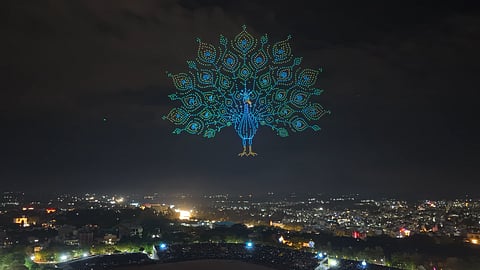

A glowing matrix of lights lifts up gracefully into the air like something straight out of a sci-fi film. Once in the air, they turn into colourful constellations that move from a soldier holding the Indian flag to a roaring lion, a Dasara jumboo with trunk lifted in salutation – one after the other, they flicker in, flicker out and leave the crowd at the recently-concluded Mysuru Dasara celebration in awe. This year, the display, specifically one of a preening peacock, set a new Guinness World Record for the largest aerial display of a bird with 3,473 drones.
For the last five years, Tanmay Bunkar, CEO and co-founder, BotLab Dynamics and his team have been behind making these dynamic light shows happen at the Mysuru Dasara. The process begins months in advance, with sketches and an animation, shares Bunkar, adding, “Our animators sketch out these formations and the transitions in between, colouring them in so we get an idea of what they will look like in the sky. Certain formations are repeated, like the Ambaari, because it is part of the culture of Dasara but others are new, like last year’s tiger was swapped for a lion. For the record display, we chose a peacock because the complexity of the formation and pattern of the feathers made it look really vivid.”

Halfway into the process, though, came unexpected competition with a team in Libya breaking the record with 3,000 drones, causing Bunkar and his team to up the ante to 3,473.The drones in the sky are ones built by the company, with Bunkar pointing out that they are smaller and lighter than the ones most people have encountered being used for videography at events. Each of these devices is programmed to follow separate flight paths with a special GPS system ‘acting like a drumbeat keeping a parade on beat.’Bunkar adds, “People think GPS just gives you position, but it also gives you precise time. What is different with these drones is the accuracy – normally GPS gives you accuracy upto 5 metres, the GNSS unit we’ve developed is accurate upto 10 centimetres. With that accuracy, we can place the drones close to each other. As long as the sensors are functional, they will not collide.” He adds, “If there are 3,500 drones, we need 3,500 files that need to be executed precisely in terms of the colour it needs to be showing and its exact location at any given time. We could recreate the formation anywhere in the world, by reorienting it according to the GPS coordinates.”
The most challenging part though is a logistical necessity. “It takes almost a day to prepare the ground – we had to mark a large 50x70 grid for this, and had to know exactly where each drone goes,” he says.
The recent display was the company’s sixth world record, with last year’s Dasara setting a record with a tiger display. Among the many major events the team has taken their work to, two stand out the most for Bunkar: the IPL 2026 closing ceremony and the beating retreat ceremony at the Rastrapathi Bhavan on the eve of Republic Day in 2022. “The next display I’m proud of is the IPL. As I’m from Ujjain, the Shiv Tandav concept was very close to my heart,” he concludes.