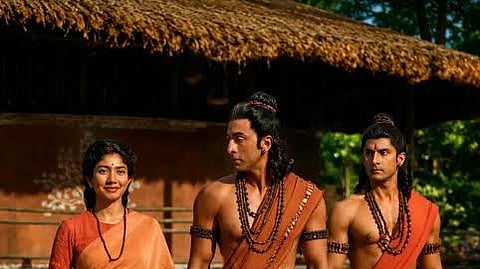

Though the story and characters of the Ramayana are familiar to generations, every time someone chooses to retell it, it is bound to raise many eyebrows, with audiences scrutinising every creative choice. So when Nitesh Tiwari’s ambitious adaptation, Ramayana: Part I, was announced, its casting became a talking point long before it reached theatres. Even after the film’s release, the debate around Ranbir Kapoor as Rama, Sai Pallavi as Sita and Yash as Ravana continued.
While questions were raised about whether the actors fit the characters, Sai Pallavi’s casting and portrayal of Sita drew particular attention, with comparisons to earlier screen portrayals and discussions around her appearance, performance and the reason behind these choices. The debate has also found its way into the film industry, with veteran actors Mukesh Khanna and Annu Kapoor, expressing reservations about the film’s choices, while actor Dhanush came out in support of Sai Pallavi.
But what makes a casting choice appropriate anyway for a character very much embedded in public imagination? Is it an actor’s resemblance to an established image, their ability to inhabit the role or the freedom to offer a new interpretation? CE turns to Bengaluru’s avid movie watchers and film experts to share their perspectives.

It is an interesting and ambitious casting choice. Each of these actors brings a distinct screen personality and acting vocabulary to the characters. As a theatre-maker, I believe casting should be about an actor’s ability to inhabit a character rather than merely resemble an established image of that character. Sita is not just about physical beauty, grace or a particular way of dressing. She represents extraordinary strength, dignity, conviction, resilience and emotional depth. I strongly believe filmmakers and theatre-makers must have the freedom to interpret, question and reimagine stories.
Clearly, the story and all choices made were tweaked so that today’s generation would accept it, and the portrayal of Sita is the best example of this. Sita was a princess who lived in complete luxury, and she chose to give it all up and go to the forest with her husband for 14 years. That took real strength and a lot of will. The scenes where Sai Pallavi fights with a sword didn’t sit with me. Giving someone like Sita a sword doesn’t make them stronger, and not having a physical fight doesn’t make someone weak. Ranbir Kapoor and Sai Pallavi were a miscast. Sita’s strength was in her choices, not in wielding a sword. I wasn’t as convinced by their representation of Rama and Sita. But I really liked Yash as Ravana. He did an amazing job, and that character had the most impact.
When I took my grandmother to watch the film, she had barely any idea who Ranbir or Sai Pallavi were. She knew Yash, being from Karnataka, and by the end of the movie, she was really happy with all three portrayals. She was watching the characters, whereas many of us tend to watch the actors playing those characters. With Ranbir, people walked in with Animal and everything else they knew about him in their heads. So it takes some effort to separate the actor from the character because our preconceived notions influence our judgements. With Sai Pallavi, I’m quite comfortable with the choice. An actor’s own personality adds another layer. Traditionally, actors playing Sita have largely stayed within a register of grace, poise and restraint. Grace and restraint are qualities that come naturally to Sai Pallavi. Some felt her expressions were a little deadpan in certain sequences. But Sita goes through more emotional turmoil than almost anyone in the epic, and there’s a lot more scope to show that in the sequel
Ranbir’s urban image sits uneasily with the gravity of Rama, though it may also be a deliberate attempt to reinvent him. Sai Pallavi’s reputation for naturalistic, non-glamorous roles makes her a convincing Sita. A female actor seen as glamorous, urban or outspoken is scrutinised more, while one seen as simple is accepted more easily. Shaped by the rise of Hindu nationalism, box office dynamics and audience tastes, casting now depends on maintaining a clean off-screen image, since the stars carry public expectations of morality and religion alongside their star power. The inclusion of South stars also points to a pan-India market strategy. There have been comparisons with the Doordarshan Ramayana, which was inevitable. That serial’s cast became iconic through nostalgia and sincerity, whereas this film must justify its choices through scale and star value. Sai Pallavi’s naturalistic roles and her reported refusal of a fairness cream endorsement fit this expectation of a ‘clean’ image, which is why she is welcomed.
Ranbir Kapoor as Lord Rama, Sai Pallavi as Sita and Yash as Ravana are perfectly matched, with very disciplined acting. I have seen Adipurush, and it was a failure. Kriti Sanon as Sita could not deliver the image of Sita, whereas Sai Pallavi performed with grace, emotion and inner strength and was true to the role. I rate Sai Pallavi much better than Kriti Sanon in Adipurush. Yash’s performance as Ravana has been matched perfectly and is much better than Saif Ali Khan’s portrayal. Ranbir Kapoor, though initially in doubt, is an intelligent actor. He performed well and presented the role in originality. The film is much better than Adipurush.
All three are interesting casting choices, especially because they bring very different screen personas to these characters. I think the actors should be given the space to bring their own interpretation to the characters, while remaining respectful of what these characters mean to people. Female actors often face more criticism about their appearance, expressions, body language and whether they fit the image people have of the character. But when it comes to Sita, there seems to be a much narrower expectation of how she should look and behave. We can respect our beliefs and still allow filmmakers and actors some creative freedom.