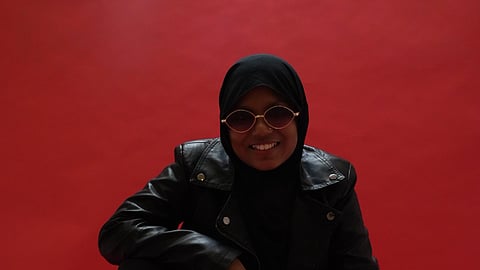

When Saniya MQ first takes the stage, all expectations of what a rapper should look like fly out the window. Usually dressed in a simple kurta and a hijab covering her head, the artiste from Mumbai’s Govandi has been dubbed the ‘hijabi rapper’ and ‘gully girl’. When she lets her self-written lyrics, sharp and cutting to the core of whatever she has chosen to speak on, whether it’s news of sexual assault and corruption, war or limitations placed on women, any stereotypes look meaningless. Speaking to CE ahead of her performance at Maya Bazaar over the weekend, she reflected on the attention she receives due to this choice. “I think it seems different to people because there are many stereotypes associated with the hijab. But rappers are meant to portray themselves as they are. Because I normally wear the hijab, I rap with it. I also hoped that my wearing it would normalise it more; you don’t see it often in mainstream media,” she says.
Saniya traces the roots of her writing to penning Urdu poetry; then, in 8th standard, she started experimenting with rap inspired by rapper Divine, whom she continues to admire.
She raps with style and confidence, often about aspirations beyond the limitations of poverty and of bridging communal tensions. To do this, she says she did not have to consciously ‘think about a topic because these issues were around me in the areas I grew up’. She adds, “Sometimes I have a line and make the whole song in that flow. Other times, I like a beat, say a random line and from that, a topic emerges.” As she’s worked with more collaborators, though, her process has expanded too. “I used to see rap as only lyrical, but I’m now thinking about the music and emotion I want to drive with the track more,” she shares.
She learnt to perform through performances on streets, she shares, before a talent show, Hunarbaaz, brought the attention of mainstream audiences. “I was a very introverted kid, but there were NGOs that would give me the opportunity to perform and pay me for it. Looking back, I feel a lot of gratitude because I didn’t think I would get to big stages; I just started because I needed to pay my fees,” she says candidly.
This year, she’s been releasing a series of singles; among them is Daag, a hard-hitting track speaking of issues that made the news this year, and she has more, including her first love song, in the works. But when asked about her biggest goal, she brings up a dream she mentions in her tongue-in-cheek recent song called Fumble Freeverse. “I have a dream that Shah Rukh Khan will call and ask me to make a title track for his film. I believe in manifesting. When Rap 91 [a major hip-hop festival by Spotify] happened last year, I manifested that I would perform, and this year, I am. I know this too will definitely come true,” she says with a smile.
