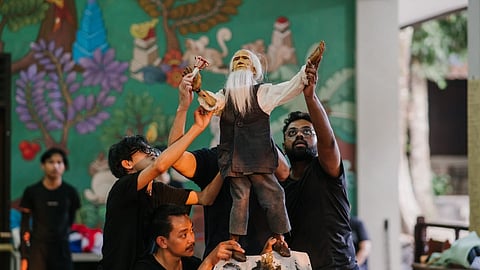

In puppetry, there is a moment when the line between an object and a living being begins to blur. Suddenly a hand moves, a head turns, a body seems to breathe and, before we know it, what was once only wood, cloth or paper appears to have a life of its own. At Pesta Boneka, an international puppetry biennale in Yogyakarta, Indonesia, Bengaluru theatre-makers Gagan Prasad and Joseph John explored this transformation alongside artistes from across the world. Organised by Paper Moon Puppet Company, the festival which concluded on October 11, selected 12 artistes from eight countries through an open call.
The duo was part of Shank’s Mare, an international production directed by American theatre-maker Tom Lee that opened the festival. The contemporary, non-verbal production follows an astronomer, a girl and another character on a journey towards their destiny, using puppets, live actors, music and multimedia projections. For Prasad and John, the experience meant stepping beyond familiar conventions of theatre and puppetry. “We always felt that the puppeteer is not seen. But here, as actors, we are also looking at how the actor can interact with the puppet, or how the actor can push the puppet forward to continue telling the story,” says Prasad.
The production draws on Bunraku, a Japanese puppetry tradition, alongside contemporary techniques. One method explored was ‘puppetry on cart’, which allows performers to operate puppets with fewer people. Miniature sets are filmed and projected onto a larger screen, creating expansive landscapes behind the puppets and live performers. Prasad operates a life-sized deer, while John handles a goddess puppet called Shaka. The 12 performers keep switching between puppets, prioritising the flow of the story over individual characters. “It is more about keeping the story alive,” says Prasad.
John brings nearly 38 years of theatre experience, while Prasad has spent a decade in the field. Their work includes Kannada plays, often marked by movement, colour and theatre songs. At Pesta Boneka, however, they were primarily there to learn about the form, its mechanisms and how to make puppets lighter and more expressive.
The festival has also challenged their perception of puppetry as entertainment primarily for children. “I came in with that mentality that puppetry is for children. But it has depth. It can tell the harshest truth in a way that you can receive very well,” says Prasad.
The experience has also left him thinking about art’s place in a technology-driven world. While social media and technology can help artistes reach audiences, he believes they cannot replace what art offers. “We should use technology to find ways to make our storytelling more effective. Without art, a society just becomes dry,” he says. So for him, puppetry is an example of how even an inanimate object can communicate complex human feelings. “There is a limit to logic, but there is never a limit to feeling,” he says, describing what the biennale experience has reinforced for him.
