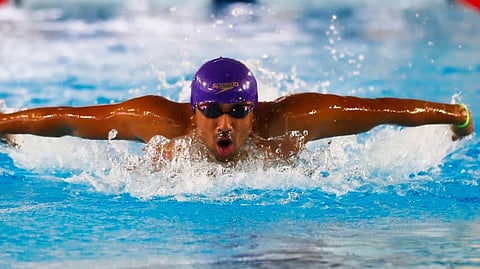

Twelve years after making his Asian Para Games debut as an 18-year-old, Bengaluru para swimmer Niranjan Mukund is preparing to represent India at the continental event for the fourth consecutive time. Having competed at the Paralympics, Commonwealth Games and World Championships, he has gained experience on some of the biggest stages in para swimming. Yet, the nervousness he calls part of the game and the excitement of wearing the Indian colours remains unchanged. “It feels like my first game. But having the chance to represent the country at top-level competitions definitely shaped me into a better athlete, a better swimmer,” says Mukund, who is looking forward to competing at the Asian Para Games in Nagoya, Japan, on October 19.
His career has evolved, so has his approach to preparation, with overseas training offering him greater exposure to competition and new ways to assess his performance. In preparation for the Games, Mukund spent five weeks training in Malaysia under Australian coach Dick Orville before returning to Bengaluru. He is expected to spend a few more days tapering his training under his Indian coach of 23 years, John Christopher, before flying to Japan.
Despite the common perception that training abroad means better facilities and coaching, Mukund says the real advantage lies in the greater exposure to competition and the opportunity to train alongside swimmers with similar disabilities. “There are a lot more competitions that happen abroad, whereas, particularly in India or in Asia, we have very little competition. So, the exposure is pretty less compared to Europe or the US,” he says. Training alongside swimmers with similar disabilities also allows him to study their strokes and participate in mock races, helping him assess his performance. While international exposure remains important, he believes Indian swimming is gradually catching up with developments in sports science and technology.
Technology has also changed the way athletes monitor their performance. Heart-rate monitoring and tools that track stroke patterns and lap timings have become part of training, helping swimmers understand their performance in greater detail. “We have had so much advancement that it tells us our stroke, how fast we swam in each lap,” he says, adding that he has witnessed a significant positive change in training methods over the years. Beyond training facilities and technology, he believes greater audience support can give athletes an additional morale boost as they compete on the international stage.

Mukund was born with spina bifida, a condition affecting the spine and both his legs. “I had to undergo 19 surgeries since birth. I took up swimming as part of aqua therapy. It just turned into a competitive sport,” he shares. He believes that setbacks should not be seen as the end of the road. “There are 99 ways to give up and 1 reason to keep going. I choose the latter because there’s always a second chance.”
As he prepares for his next, Mukund feels grateful. “I feel like the dinosaur of the team. I was there in 2014 and now in 2026,” he laughs. For him, the milestone is not just about consecutive appearances but also about the opportunity to represent India once again. “That pride of wearing the tri-colour at this stage is what excites me. And, obviously, to give my best there and make the country proud,” he smiles before signing off.