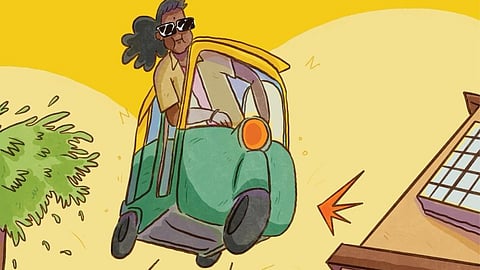

As the scorching sun blares its heat on everyone below, an auto moves through the city with a ‘phut phut’ – a little boy named Ravi and his mother inside on the lookout for his lost water bottle. As the friendly auto akka navigates through the city’s neighborhood roads, ones lined in high rises, and others lined in trees, Ravi learns and feels what it means to navigate Bengaluru’s ever-increasing urban heat.
Unfolding in Auto Akka and the Hot Seat, this story conveys the impact of the climate crisis through simple language and beautiful illustrations (by Radha Patkar) that kids can easily understand. Ujjvala Krishna, one of the authors alongside Nithya Gowda and Lakshita Munjal, shares, “The idea grew out of my work as a researcher. I have worked specifically on urban heat in Bengaluru, and I spend a lot of time looking at climate change and the built environment. But I do not like the idea that research should just stay stuck in academic papers or policy reports. People care about their city, but they don’t always get to engage with the data. Climate data is often inaccessible to the public, let alone children. Our team is a mix of an urban planner, a climate researcher, an architect and an illustrator. We wanted to find a fun way to translate that research into something tangible.”
Choosing an auto ride as a way to move through the city was a way to show how the temperature can shift with neighbourhoods. Krishna explains, “A leafy shaded lane feels completely different from a concretised junction. Moving through the city in an auto lets us highlight those different heat microclimates visually and also narrative-wise.”
Auto Akka, through whose experiences readers understand the day in and day out impact of rising temperatures on working Bengalureans, was originally an auto anna. But conversations with women auto drivers during the team’s research process, resulted in them changing the character’s gender. “Making the driver a woman then became intentional. They are navigating spaces that are overwhelmingly male dominated. Women in the informal workforce also often experience the physical environment, lack of infrastructure, and public space very differently. For example, women drivers do not drink a lot of water during hot days, because they do not have access to public toilets, and hence, suffer from dehydration.”

The book also weaves the city’s animal life into the story – while Ravi’s bottle remains lost to him, it is found by a thirsty crow in a hopeful ending. With the book, Krishna hopes that kids leave feeling curious about their own neighbourhoods and empathy for street workers and gig workers, part of that curiosity was evident with the workshops that accompanied the recent reading events for the book held across the city’s bookstores, including Beku – Cafe Bakery Bookstore. “Right after we read the book, when their minds are already buzzing with ideas, we gave the kids a simple outline of an auto rickshaw and ask them to design a ‘cool’ resilient auto. And their imaginations have just blown us away. They came up with everything from rooftop gardens and built in water mist fans to a mini aquarium, to a force field, and even a stock of tender coconuts in the back. One child designed a whole condensation evaporation system inside the auto to harvest and filter drinking water for passengers,” she says, concluding, “Kids pick up on climate and urban heat concepts remarkably fast, and when you give them an open canvas, they tackle real city problems with a lot of creativity!”