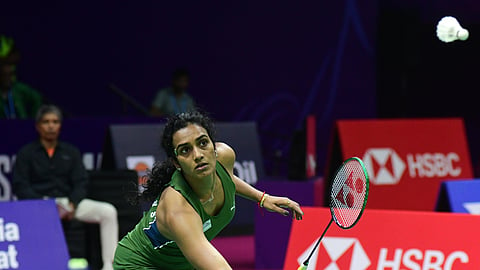

Whenever badminton star PV Sindhu walked onto the court in the past few months, viewers’ eyes were drawn not just to her game but to the oddly futuristic, bean-shaped device stuck to her temple. Aptly named ‘Temple,’ the device by Zomato founder Deepinder Goyal claims to measure blood flow to the brain. She’s not the only elite sportsperson spotted wearing wearable tech either, with Virat Kohli often seen with a Whoop band. However, there is more to sports tech than the buzz around wearables.
Sayak Ghosh, founder, StepOut AI, explains the different ways tech is used in sports today, saying, “It comes in the form of performance analysis or enhancement: one is wearable devices like Whoop or chest bands that track physical data and the other is technical analysis, which used to be done by support staff manually, but is now being done by organisations like us. You also see goal line technology like the FIFA World Cup’s chip in the ball, which helps both in performance analysis as well as officiating or governance.” Currently, his software, which uses AI to analyse football games from uploaded footage, has been used by the All India Football Federation’s FIFA Academy, the I-League, the Durand Cup and ISL teams Bengaluru FC and FC Madras.
Cricket, founders note, is perhaps where sports tech use is most prevalent, with one example being smart bats by Bengaluru-based Str8bat, used by IPL teams like Rajasthan Royals (RR) for player development and acquisition. The tech consists of a thin sticker, explains founder Gagan Daga. “It is IoT-enabled and goes behind the bat, capturing motion without cameras. It gives feedback to every player on bat speed, impact, timing and biomechanics of the batting,” he says.
It was also used to scout teenage phenomenon, Vaibhav Suryavanshi. Daga adds, “RR uses the bat for trials, and the data goes into their talent auction strategy. Suryavanshi had come into trials, and his batting speed was around 95 kmph. Afterwards, they could improve his batting speed by around 12 per cent.”
Hariharan, a reserve team analyst with Bengaluru FC, offers a support team’s perspective, sharing that across India’s football teams, tech like Catapult, which tracks running data through a clip-on device and Veo, an AI-powered sports camera, are common too.
For him, the biggest advantage of using a set of different devices has been saving time spent on analysis, while much of the planning and strategy still needs a human brain. “This helps us with individual player profiles. I’ll get everything like how many passes he did, short passes, long passes, how many shots he blocked, etc. But in terms of overall positioning, the philosophy with which we are going to play in zone one and zone two, how we are going to finish the attack, is something I do ourselves,” he says.
Dr KS Kushalappa, consultant, Orthopaedic Surgery, Narayana Health City, shares that wearable devices available in the market are different from tech being used in elite training or in sports medicine settings. “The difference is in the accuracy and the analysis. My smartwatch might tell me my VO2 max, but it is a rough estimate. With an elite athlete, we would put them onto a treadmill, hook up a breathing device, check their heart rate and we pace them through different levels of intensity, which makes a difference. The scoring systems on wearable devices also often have no real science behind them.” One area where sports tech is used in medicine is rehab, he shares, “We use a lot of AI-based video analysis for our patients who are going through rehab or those who are trying to understand biomechanical issues. We have also used such analysis to break down how their rehab is progressing.”
