
BENGALURU: “Development can be pursued without weakening environmental safeguards,” said experts amid the ongoing protest against the Karnataka Government Parks (Preservation) (Amendment) Bill, 2026.
They questioned legislation that allows 5% of parkland to be used for development projects and warned that the provision could become a gateway to gradual erosion of the state’s remaining green cover. They cautioned that the repeated diversion of parkland could worsen air pollution, affect public health and undermine Bengaluru’s identity as ‘Garden City’.
V Ram Prasad, environmentalist and co-founder of Friends of Lakes, strongly criticised the Bill, calling it a “blatant and careless abuse of power and public trust”. He pointed out that Bengaluru’s green cover and lung spaces have steadily declined from around 60% in the 1970s to 40% in the 1990s, 20% in the 2010s and now to a single digit. “We cannot afford to lose more,” he cautioned.
Questioning the 5% provision, he said, “Even without this, developmental works have been taking place so far in Karnataka. Projects requiring green spaces could still be taken up by following due process and obtaining necessary environmental clearances.”
He objected to terming those opposed to the Bill as “anti-development” and called the proposed legislation ‘ridiculous’.
Bangalore Apartments’ Federation (BAF) and Bengaluru NavaNirmana Party founder Srikanth Narasimhan said his biggest concern about the Bill is lack of clarity over how many times the “one-time” provision could be used. “Would it genuinely be a one-time measure or whether another 5% could be taken whenever an infrastructure project is proposed,” he asked.
“If another 5% is added after 10 years, the parks we have today could be significantly reduced, and the loss may eventually be forgotten. This is a retrograde law that will further weaken Bengaluru’s identity. We are already losing the Garden City tag and becoming a concrete city.

Bengaluru was also known as a city of lakes and gardens. The continued diversion of green spaces could destroy the city’s unique character that was distinctive once,” he said.
Professor of Practice at Vemana Institute of Technology, Karegowdra Jayanna, said Bengaluru, with over one crore vehicles and a population exceeding 1.4 crore, is already facing serious air-pollution challenges.
He said vehicle emissions contain poisonous gases that can cause breathing difficulties, lung problems, eye irritation, headaches and skin irritation. While technologies such as electronically controlled common-rail fuel-injection systems have helped reduce vehicular emissions, protecting the city’s remaining green cover remains essential. “Trees absorb pollutants and play an important role in maintaining clean air,” he said, warning that removing trees or reducing park spaces could worsen pollution and directly affect public health.
‘Bill may worsen Bengaluru’s climate, pollution’
The loss of greenery could intensify the urban heat-island effect and increase flooding and pollution.
Narasimhan warned that the Bill, which is to make way for the tunnel road project, could worsen the impact of climate change. He said the consequences would be particularly severe for vulnerable sections of society, including domestic workers, delivery personnel and pourakarmikas, who work outdoors and depend on trees and shaded spaces for relief from extreme heat. He pointed to the role of parks in holding rainwater and recharging groundwater. Converting parks into concrete spaces could increase flooding and impact Bengaluru’s water-recharging capacity, he added.
Jayanna opposed tunnel projects in Bengaluru, saying completing the remaining Metro Rail projects would significantly improve traffic conditions without the need for large-scale underground infrastructure. “Bengaluru already has several problems, and weakening the earth beneath could create further concerns,” he said. He stressed the need to increase greenery to improve public health and reduce pollution. “We should encourage more replantation and prevent damage to nature. More greenery will definitely improve the health of Bengaluru and help reduce the impact of pollution,” he said.
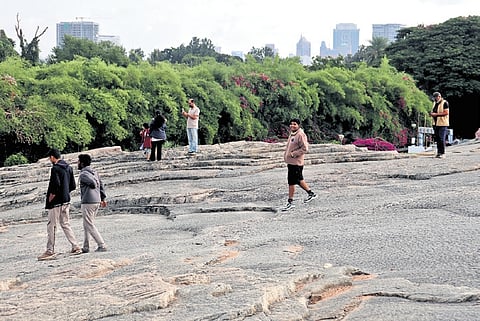
Prasad said that even if “five acres of Lalbagh may go”, the larger concern is what the move would mean for the city’s future. He added that the city once had a much cooler climate, with residents often able to live comfortably without fans during summer. Today, increased dependence on air-conditioners reflects the loss of tree cover and changing weather conditions, he said.