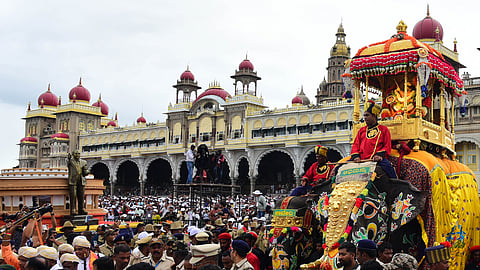

Colourfully-painted elephants walk with a measured pace, making their way down the road, even pausing to wave their trunks at the crowd of thousands gathered to watch. Even among their deafening cheers, the folk performers, security officials, elaborate floats surrounding them – these giants stay cool and do what their kin have done for over 400 years now as a part of the Mysuru Dasara celebrations. In recent years, Abhimanyu, the tusker who was a part of the procession for the last 20 years and the one who has carried the 750kg golden howdah since 2020, was, perhaps, the most beloved. He was also an accomplished kumki elephant, helping capture more than 300 wild elephants and 80 tigers working alongside the forest department. As the jumbo retires from his duties at age 60 this year, here’s a close look at these creatures.

Making of a Dasara jumbo
Until the 1970s, elephants for Dasara were captured using a process called ‘khedda’, in which herds of elephants were surrounded and trapped, often using acoustic disorientation. Wildlife biologist and programme head at Holématthi Nature Foundation, Sanjay Gubbi, explains, “It is a way of corralling elephants and capturing a large number of them which was prevalent in Karnataka, especially in the Nagarhole region. My mother and uncles who come from that area had gone to the last keda operation (in 1971), and they tell me even now about officers giving them bamboo rattles to play during the operation.”
Today, they are chosen among the 14 elephant camps in the state by a team of officials which examines the animals, shares Kumar Pushkar, Principal Chief Conservator of Forests (Wildlife) and Chief Wildlife Warden for the state of Karnataka, adding, “We form a team of experts – including vets, and go through each elephant’s health records, temperament and response to the commands of mahouts. Dasara has lakhs of people and different sounds which elephants are not accustomed to, so in case of any history of indiscipline, those elephants are not chosen. Two-three among the chosen ones are trained to carry the howda and in the last 10-15 days, we select one.”
Now that elephants have been selected and sent to Mysore, their days will involve training to get them used to the crowds and distractions through daily walks through the city. The bond between mahouts and the elephants is crucial to the process and thus, they are brought with the jumbo to Mysuru and stay with them. “Mahouts, with a support team, train the elephants and control the animal amongst the crowds,” says Prajna Chowta, founder, Aane Mane Foundation.
What are kumki elephants?
While not all elephants chosen for Dasara this year are kumki elephants, most are, shares Pushkar. They work with forest officials in situations where animals need to be captured in cases of human-wildlife conflict. Pushkar explains, “With kumkis we can access deep areas of the forest inaccessible by vehicles to capture tigers, leopards or elephants. They’re essential for the safety of veterinarians and the capture team who coordinate to dart the animal. They are trained so that they do not fear or run from wild elephants who charge at our team. A few years ago, when a vet tried to tranquilise on foot before the kumki got there, it resulted in him getting trampled with punctured lungs which took a long time to recover from.”
Their training takes years at a time and older camps excel at producing great kumkis says Pushkar, adding, “The oldest camps are Dubaare in Matigod and Nagarhole in Madikeri, which are the traditional areas where elephants used to be captured. These elephants have been trained for a long time so most [kumkis] come from there.” He adds, “After an elephant is captured and put in a kraal (wooden enclosure), in three months, it starts obeying commands. To become eligible for Dasara, it takes a minimum of three years.”
While kumkis are used in India, other parts of the world have different methods of capturing wild elephants, explains Gubbi, saying “Taming African elephants is difficult. So most times, they are captured through helicopter and tranquilisation. India is a unique place where they use kumki elephants as are the mahouts and kavadis who are trained in this tradition of handling elephants.”
However, he cautions against a culture of glorifying captive elephants while villainising wild elephants, prevalent on social media platforms where videos of capture operations are spread, which is counterproductive to conservation efforts. “While memorials and tributes are being built for captive elephants, there appears to be little emphasis by the same groups on supporting the conservation of wild elephants and protecting their increasingly threatened habitats. Elephant conservation should ultimately be about securing the future of wild elephants and the landscapes they depend on—not turning captivity into a spectacle.”
“From the time of Krishnaraja Wadiyar, Dasara elephants used to be kept in Mysore Palace in huge elephant stables called the Anekaroti, with a dedicated space for each elephant. When they needed to go to the forest, they were sent to Kabini. My father (Jayachamarajendra Wadiyar) was very fond of animals and during Dasara, we used to go there almost every evening and feed them sugarcanes and staw-packed treats filled with jaggery and rice, the elephants used to love sweet things! Back then, the ambaari elephant was a huge one named Biligire. He had a great temperament and was always very calm and serene. Even the mahouts used to praise him. He carried the howdah for 10-15 years and even carried the ambaari for my eldest sister when she got married. By my wedding in 1971 though, he had grown old so his successor Rajendra carried my husband and I on the golden howdah after the ceremonies were done. I was a little nervous about getting on wearing a saree but it was a surprisingly smooth journey!
Apart from Biligiri, we had a pattada aane named Hamsaraj who was trained to shower flowers on the throne at Dasara – he was a little cranky sometimes. There was also a patada kudre and patada hasa as kings are supposed to have. If I remember correctly, the pattada kudre had a royal funeral when it died. By the time Hamsaraj passed though, he was quite old and was part of the forest department. As we had lost all the privileges things had changed. There were no processions apart from Dasara.”