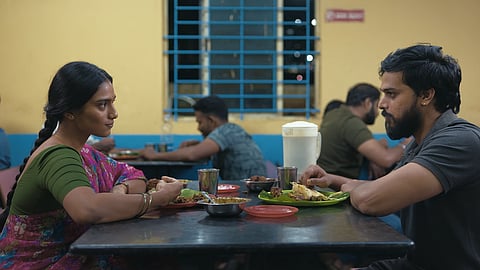

What happens when the profession you inherit becomes the very thing you want to leave behind? For filmmaker Aniketh Terdal, that question became the starting point for Kasubu (Craft), his award-winning short film that explores dignity and the choices available to those caught within generational occupations.
Directed and co-written by Terdal, Kasubu which won Best Script and Best Film award at Bengaluru International Short Film Festival follows a newly-married couple whose relationship is tested when the husband’s profession as a sanitation supervisor becomes a source of conflict. The film’s central idea came from an anecdote involving Mahatma Gandhi and Dr BR Ambedkar.
Terdal recalls the two visiting Maharashtra for a protest concerning slum dwellers. While Gandhi stayed in a slum, Ambedkar stayed in a hotel. When journalists questioned Ambedkar about the apparent contradiction, his response stayed with Aniketh – the goal should not be to romanticise poverty or hardship, but to ensure people have the freedom to move beyond it. “When you don’t have respect or dignity, there is no point in staying there and calling it your generational job,” he adds.

The film also marks a personal challenge for Terdal. “After being in the industry for 10 years, I felt I should do a short film. It was a challenge for myself,” he says. He started off as an assistant director for TV serial Amrutha Varshini, before moving into films. He later worked on Hemanth M Rao’s Sapta Sagaradaache Ello. He is currently co-directing Operation Dream Theatre, starring Shiva Rajkumar and Dhananjaya.
Kasubu’s award run also made him rethink how socio-political stories can reach audiences. Aniketh wanted the short film to remain relatable. “How we creatively tell stories of injustice matters, particularly when attempting to bring lesser-told stories to Kannada audiences,” he says.
Talking further about independent filmmaking, he believes it comes down to preparation, and that inspiration alone is not enough. Perhaps that is also what Kasubu represents for him: a decade of learning distilled into one film, made as a test of what he has learnt.