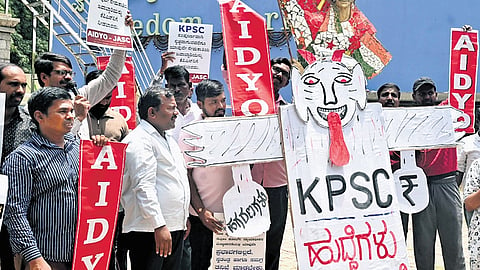

BENGALURU: Members of the Job Aspirants’ Struggle Committee (JASC) and All-India Democratic Youth Organisation (AIDYO), Karnataka State Committee, protested at Freedom Park on Friday, demanding a complete overhaul of the Karnataka Public Service Commission (KPSC) and a transparent recruitment system.
The protesters alleged that recurring irregularities, question paper leaks, recruitment malpractice and delays in appointments by KPSC have affected the prospects of lakhs of job aspirants. They demanded that the government restore confidence in the recruitment process and implement the recommendations of the PC Hota Committee for reforms in KPSC.
AIDYO state secretary Siddalinga Bagewadi told protesters that KPSC, which is expected to provide a fair opportunity to young people seeking government jobs, has faced allegations of irregularities in recruitment and examinations over the years. He referred to KPSC controversies dating back to 1998-99, examination irregularities in 2011, FDA question paper leak in 2014, allegations of marks tampering in 2019 and recent allegations concerning PDO recruitment, OMR sheet tampering in assistant executive engineer recruitment, KAS examinations and veterinary officer recruitment. He said such controversies have affected the time, effort and future prospects of job aspirants and demanded accountability in the recruitment process.
Bhavani Shankar Gowda, co-convener, JASC, demanded that KPSC be made an independent, transparent and accountable institution. The organisations sought an independent investigation under the supervision of a sitting High Court or Supreme Court judge into recruitments conducted over the past five to six years. They also demanded that corruption cases be tried in fast-track courts and that those found guilty be punished.
