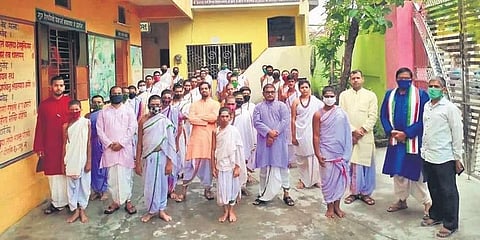

BHUBANESWAR: In an age where education is governed by smartphones and social media, two educational institutions in Odisha present a stark contrast.
The Vedapathsala at Berhampur and Sri Garuddhwaz Vasudev Yugvalkya Vedapathsala at Puri are the only institutions in the State today where young boys are taught all the four Vedas - Rig Veda (which is the oldest), Yajur Veda, Sama Veda and the Atharva Veda - in age-old gurukul style. Along with Vedas, they are also taught English, Mathematics, Science, Odia, Sanskrit and Social Sciences to make them eligible for mainstream education.
Governed by Maharishi Sandipani Rashtriya Ved Vidya Pratishthan at Ujjain, an independent body under the Ministry of Education, both the institutions provide degrees in Veda Bhushan and Veda Vibhushan (Class VI to XII) which are equivalent to Class X and Class XII respectively and can be used for admission to college. Residential in nature, the Vedapathsalas do not charge a penny from the children and instead pay them a stipend of Rs 1,000 every month.
At the two-decade-old Berhampur Vedapathsala, the day begins early for the 58 vidyarthis with chanting of slokas and mantras. While the mornings are meant for classes, the evenings are dedicated to ‘aratis’, sloka recitation, traditional games and music before they retire for the night by 9.30 pm. “Although it is a life of strict discipline for the vidyarthis at the school, we ensure that they are given some hours to unwind for their overall growth”, said principal Manoj Kumar Panigrahi.
The Puri Vedapathsala is currently home to 70 vidyarthis who also study the mainstream subjects apart from the Vedas. “Each child can choose to study one Veda along with the general subjects to keep up with the modern education system”, said Indramani Pati, a teacher of the institution.
Both the institutions have hired 10 to 15 teachers each to train the students with the focus being on oral recitation. Pati said while the courses are developed on the lines of CBSE, students after completing their Veda Vibhushan can pursue higher education in Veda, Vedanga or Sanskrit studies.
Both Panigrahi and Pati feel that despite the rise in the number of English medium schools, interest in Vedic studies persists which is evident from the admissions. Every year, the institutions get students from all over India, particularly West Bengal, Jharkhand, Rajasthan, Madhya Pradesh. However, the annual admissions are limited to around 10 to 15 students.
“Since we provide free education and lodging, we only take the number of students that we can afford to take care of,” said Panigrahi.
The batches are a mix of children from well to do families and those from poor economic backgrounds including orphans. Besides funds from Maharishi Sandipani Rashtriya Ved Vidya Pratishthan, the schools are managed with donations from Good Samaritans.
