
BHUBANESWAR: Days after the collapse of a portion of the bridge on NH-16 in Jajpur district due to structural failure, the National Highway Authority of India (NHAI) has come under the scanner for the stagnation of rainwater on the flyovers passing through the capital city.
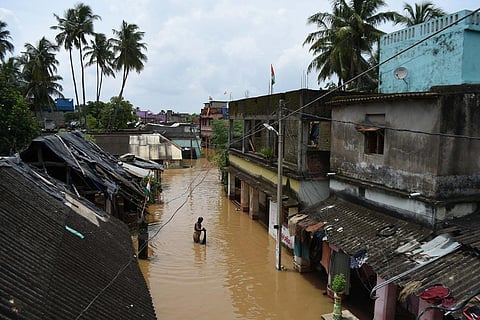
The three-hour heavy downpour on Monday not only inundated the arterial roads, lanes, by-lanes and residential areas in the city but also flooded the NH-16 between Cuttack and Bhubaneswar besides overbridge at several locations between Rasulgarh and Khandagiri causing severe disruption to vehicular movement.
“If flooding of service roads was not enough, this time we experienced huge water stagnation on the flyover. It appeared like a narrow river at some locations. We had never experienced such a situation before. It was a harrowing time for bikers who took the flyover route to avoid flooded service roads,” said Biswaranjan Pati, an IT professional.

Commuters alleged the overbridge stretch from Rasulgarh to Barmunda has become a cause of concern for city residents due to its faulty design and shoddy maintenance. Since the city lacks proper drainage systems at some locations on this stretch, the flyover acts as a barrier preventing drainage of rainwater.
Moreover, stagnant water in asphalt-overlaid bridge decks is the primary cause. Rainwater seeping through the asphalt layer also leads to the degradation of the asphalt pavement and the underlying concrete deck.
Risk analysis expert Prasanta Kumar Padhi, who had predicted NH-60 flooding in 2002 due to lack of adequate passage for the discharge of rainwater from one side to the other, maintained that one size does not fit all. “The discharge mechanism from the top of the overbridge is inadequate for a heavy downpour in a short duration. But surprisingly, NHAI adopts a standard size of scupper, which it uses across the country, to evacuate rainwater from the top of overbridges,” he said.
The size of scuppers, Padhi said, has to be increased with discharge pipes leading to the ground level. Besides, regular maintenance by NH authorities to keep the screens of scuppers clean is the need of the hour, he added.
NH authorities, however, blamed the sand-laden trucks for the overbridge flooding. NH project director (Bhubaneswar) Narendra Singh said the drain pipes were choked in sand causing the water stagnation.
“We have raised the issue with the state government several times urging them to regulate sand-laden trucks and not allow such trucks without cover. As part of an immediate measure, maintenance staff have been instructed to keep the pipes cleaned to prevent reoccurrence of the situation,” he added.