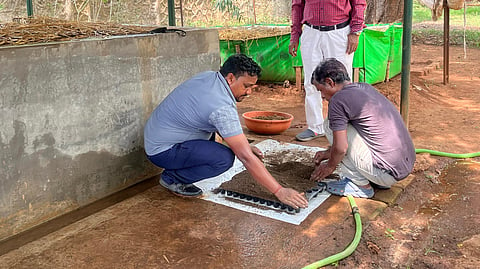

ROURKELA: While most people look forward to a quiet retired life,66-year-old Gokul Minz chose a different path. Soon after retiring as a senior manager from the Rourkela Steel Plant (RSP) in 2020, he embarked on a second career with a mission to reduce farmers’ dependence on chemical fertilisers and revive soil health through scientifically developed bio-inputs.
A diploma engineer who spent decades in the steel industry, Minz has combined traditional cow-based farming practices with modern engineering to develop standardised bio-fertilisers and bio-pesticides aimed at making farming more sustainable and affordable for small and marginal cultivators.
To take his idea forward, he founded Prakriti Gau Anusandhan Kendra Private Limited (PGAKPL) in November 2020. The agri-tech startup is incubated at the Foundation for Technology and Business Incubation (FTBI) of the National Institute of Technology-Rourkela (NIT-R).
“Continuous use of synthetic nitrogen, phosphorus and potassium (NPK)-based fertilisers has stripped our soils of organic carbon over the years,” Minz said.
“Our objective is to standardise organic inputs so that farmers can reduce dependence on costly chemicals while improving soil health, crop productivity and food quality,” he added.
Engineering meets agriculture
To strengthen the scientific component of the venture, Minz teamed up with Bibhuti Bhusan Behera,an MSc graduate in Biotechnology and Bioinformatics who serves as the company’s director and oversees research on bio-fertilisers.Minz handles production, management and mechanical innovation, including designing custom granulation equipment to scale up manufacturing.
The startup has focused on developing cow dung-based bio-fertilisers by blending bio-waste, natural minerals and beneficial microorganisms in carefully calibrated proportions to overcome the inconsistencies often associated with conventional organic farming.
Though the Covid-19 pandemic delayed progress, PGAKPL has spent the last four years carrying out intensive research and development with support from the departments of Food Process Engineering and Chemical Engineering at NIT-R. Simultaneously, laboratory testing and field trials have continued across Sundargarh district.

Trials in farmers’ fields
The startup has conducted field demonstrations with around 50 farmers in Nuagaon and Lathikata blocks. Among them is Patrapali farmer Rameshwar Mahato who has been using the company’s bio-inputs for the past three years.
“When I first stopped using chemical fertilisers, I was worried that yields would decline. But my paddy production has remained stable, input costs have fallen significantly and the soil now retains moisture much better than before,” Mahato said.
One of the most significant demonstrations came during a pumpkin cultivation trial at Hathibari village in Nuagaon block in 2024. According to Behera, two adjacent 20-decimal plots were cultivated under identical seasonal conditions. One plot received conventional chemical fertilisers while the other was treated exclusively with the startup’s bio-fertilisers and bio-pesticides.
“The chemically treated plot produced around three quintals of pumpkin whereas the bio-input plot yielded nearly eight quintals,” Behera claimed. Importantly, it showed that scientifically standardised natural inputs can perform competitively under field conditions.
Product range
The company has developed a portfolio of bio-inputs covering different stages of crop growth. Prakriti Sanjivani is a granular organic manure prepared from cow dung, rock phosphate and natural microbial enhancers. Prakriti Sampurna is designed to improve soil health and enhance nutrient absorption by plant roots.
Similarly, Prakriti PSB uses indigenous bacterial strains collected from Sundargarh soils to improve phosphorus availability under local agro-climatic conditions while Prakriti Rakshak is a botanical bio-pesticide prepared from cattle urine and plant extracts to control insect pests without leaving toxic residues.
Minz said laboratory studies conducted at Odisha University of Agriculture and Technology (OUAT), NIT-R, IIT Indore and accredited private laboratories in Rajasthan and West Bengal have helped refine the formulations.
“It is a misconception that bio-inputs necessarily reduce crop yields,” he said adding, the results depend on the right combination of natural ingredients. “We are continuously improving our products through research and scientific validation,” Minz said.
He added that early laboratory findings suggest indigenous nitrogen-fixing bacteria collected from local soils perform better under Sundargarh’s climatic conditions than non-native microbial strains.
Addressing a growing problem
Agricultural experts have long pointed to declining soil health in Sundargarh where a large proportion of farmland has become acidic and deficient in organic carbon due to prolonged use of chemical fertilisers.
Minz believes scientifically standardised bio-inputs can help restore soil fertility while reducing cultivation costs and supporting sustainable farming. His startup is currently in the final stages of obtaining regulatory approvals and expects to begin commercial production soon.
“If we can restore soil health today, the next generation will inherit fertile land, healthier food and a farming system that is economically viable for small farmers,” he signs off.