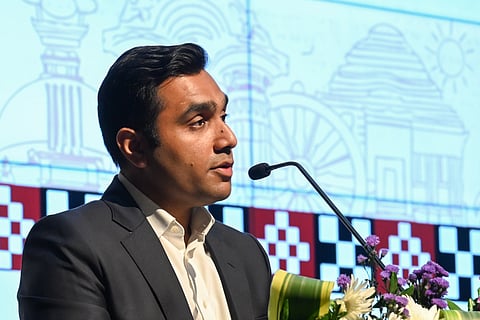

BHUBANESWAR: Managing director of Adani Ports & Special Economic Zone Ltd (APSEZ) Karan Adani on Thursday said India has the potential to emerge as a net exporter of aluminium if new capacities are built at globally competitive costs while strong domestic demand continues to leave room for multiple producers.
Speaking after the signing of the MoU with the state government for an integrated aluminium project, Adani said India’s continued dependence on aluminium imports despite the presence of large domestic producers highlights the strength of demand in the country.
“If you look at the overall market, even with such large capacities being there and large players being there, we still import aluminium, which is a sign that there is more demand and there is going to be enough room for everybody to be in this market,” Adani said.
On the proposed Odisha project, Adani said the company expects to spend the next 12 to 18 months securing statutory approvals, environmental clearances and other regulatory permissions before commencing physical construction.
“It will take us 12 to 18 months to get the approvals and post that we will start the physical construction. That is the timeline we are looking at,” he said.
Adani said the project will also require a long-term supply of bauxite and the company plans to participate in future mineral block auctions while exploring other sourcing arrangements to ensure raw material security.
“There are few mines which are coming up for auction and we will try for that. We are also looking to work with the OMC (Odisha Mining Corporation) to find a way to bauxite security,” Adani said.
Describing the investment as the company’s initial commitment in the sector, Adani said, “This is our initial investment that we are looking at and basically the idea is to bridge the gap between what is India’s requirement and also the future requirement,” he said.
