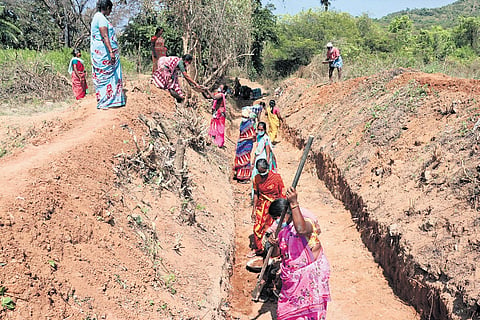

BHUBANESWAR: The Centre has released Rs 932.31 crore for Odisha as the first-quarter installment of the newly-launched Viksit Bharat-Guarantee for Rozgar and Aajeevika Mission (Gramin) (VB-G RAM-G), rolled out across the state on July 1.
The state government has committed a contribution of Rs 621.55 crore for the scheme, taking the total amount to Rs 1,553.87 crore. The central allocation comprises Rs 517.95 crore towards wages, Rs 345.30 crore for material costs and Rs 69.06 crore for administrative expenditure.
The Union budget has earmarked Rs 95,692.31 crore as the Centre’s share for the rural employment programme nationwide, of which Odisha’s allocation stands at Rs 3,763 crore.
The VB-G RAM-G scheme, which replaced the Mahatma Gandhi National Rural Employment Guarantee Scheme (MGNREGS) from July 1, guarantees a national minimum wage of Rs 300 per day. The state has adopted the benchmark wage of Rs 300, while Kerala and Haryana offer the highest daily wages at Rs 401 and Rs 409, respectively.
Panchayati Raj secretary Girish SN said the state would release its matching share on schedule to ensure timely wage payments to beneficiaries. The first installment formed part of the Rs 25,863 crore ‘Mother Sanction’, following a review meeting chaired by Union Rural Development minister Shivraj Singh Chouhan with state rural development ministers on July 5.
Source said Chouhan praised Andhra Pradesh, Kerala and Rajasthan for rapidly operationalising the programme while urging Odisha and West Bengal to commence works in all gram panchayats at the earliest. Girish said the scheme has been rolled out in all but 61 gram panchayats across the state.
Most of them have ceased to exist after they were included under the new notified area councils (NACs) and municipalities, while some panchayats were acquired for mining projects. Overall, the number of gram panchayats in the state has also reduced from 6,794 to 6,733.
Since preparation of the mandatory Viksit Gram Panchayat Plans under the new law will take time, the state has approved existing project shelves cleared by gram sabhas to ensure uninterrupted employment during the transition. The state has also requested the Centre to permit plantation-related works during the ongoing monsoon, citing restrictions on undertaking labour-intensive works during the peak agricultural season.
State Panchayati Raj minister Rabi Narayan Naik said the new programme reflects the double-engine government’s commitment to strengthening rural livelihoods. By increasing the employment guarantee from 100 days to 125 days annually, the scheme would play a significant role in improving income security for rural households in the state, he added.
