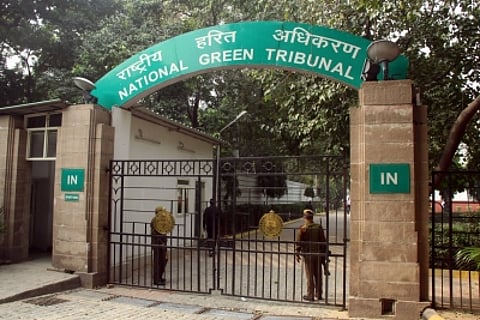

CUTTACK: The National Green Tribunal (NGT), East Zone bench, has ordered an inquiry into allegations of serious environmental and planning violations in the operation of two micro compost centres (MCCs) and a material recovery facility (MRF) inside a residential locality in Bhubaneswar.
A 71-year-old resident of Kapilaprasad Housing Board Colony in Bhubaneswar has approached the NGT with the matter. Taking note of the grievance, the bench of Judicial Member Arun Kumar Tyagi and Expert Member Ishwar Singh observed that the petition raised substantial questions relating to environment under laws listed in Schedule I of the National Green Tribunal Act, 2010.
“However, we are of the considered view that the allegations made in the petition require physical verification of the factual position by a Joint Committee comprising the representatives of the concerned state authorities,” the bench said.
The petitioner Rajkishore Swain alleged that the Bhubaneswar Municipal Corporation established and operationalised the waste processing units on government Gochar land without following the prescribed siting criteria under the Solid Waste Management Rules, 2016 and without obtaining mandatory authorisation from the State Pollution Control Board.
The NGT constituted a joint committee comprising representatives of the member secretary, OSPCB and the Khurda district magistrate. The committee has been directed to examine the complaints, associate the petitioner and project proponents during the inquiry, verify facts on site and initiate remedial measures if any environmental violations are found. It has been directed to submit its report within three months.
According to the petition, residents have been living in the colony since 1994. The disputed site, located on the western side of the colony, was originally a low-lying grazing land containing an abandoned quarry pit that naturally drained rainwater from the locality and prevented flooding of nearby streets and houses.
The petitioner contended that the land falls within a Special Residential Heritage Zone under the city development plan and was earmarked only for heritage park-like activities. Any other use, including establishment of waste management facilities, was allegedly prohibited.
The petition alleged that two separate MCC complexes of 5 tonne per day capacity each were constructed within the same campus and shown as independent units to allegedly avoid obtaining statutory environmental clearances and permissions from the pollution control authorities.
