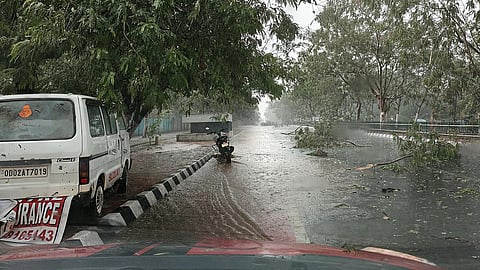

BHUBANESWAR: Thousands of residents of central part of the capital city endured prolonged power outage up to 16 hours or more following Saturday’s nor’wester, exposing glaring weaknesses in the power distribution network and raising serious concerns about Tata Power’s ability to handle larger disasters.
While the thunderstorm was intense, uprooting trees, damaging electric poles and snapping transmission lines, residents questioned why restoration efforts took so long despite a limited number of affected localities. The failure ran contrary to the government and Tata Power’s repeated claims of establishing resilient power infrastructure in the state capital.
Among the worst-hit areas were Nayapalli, Jayadev Vihar, Acharya Vihar and Saheed Nagar, where many households remained without electricity through the night into Sunday morning. The outages came during a period of intense heat and humidity, leaving families, senior citizens and children struggling without fans, air conditioners and drinking water supply in many households.
“We spent the entire night without power. There was no information on when supply will be restored. The heat was unbearable,” said a resident of Nayapalli.
Emergency teams from Odisha Fire Services and the Odisha Disaster Rapid Action Force (ODRAF) joined hands with Tata Power Central Odisha Distribution Limited (TPCODL) to clear uprooted trees and restore damaged infrastructure. Despite the deployment of multiple teams, restoration remained slow in several pockets.
TPCODL claimed that nearly 95 per cent of affected consumers had their power supply restored by the night, while the remaining five per cent received electricity on Sunday morning. However, for residents who spent more than 16 hours without power, the figures offered little consolation.
According to recorded statistics, around 2.5 lakh consumers were affected. Of these, around 80 per cent were restored by 7 pm, 90 per cent by 10 pm and 97 per cent by midnight, said a TPCODL spokesperson.
The incident has once again brought the spotlight on the state’s ongoing efforts to create a disaster-resilient electricity network. The state government has been investing heavily in underground cabling projects in Bhubaneswar, Cuttack, Puri and Berhampur to reduce vulnerability to cyclones and severe storms. A Rs 2,500 crore project covering hundreds of kilometres of 33 kV and 11 kV lines is under implementation. However, significant portions of the network remain incomplete and many areas continue to depend on overhead lines vulnerable to falling trees and strong winds.
Power experts argued that if restoration in a few affected pockets of the state capital requires more than half-a-day despite support from multiple government agencies, one can imagine the time taken for restoring power after a major cyclone.
