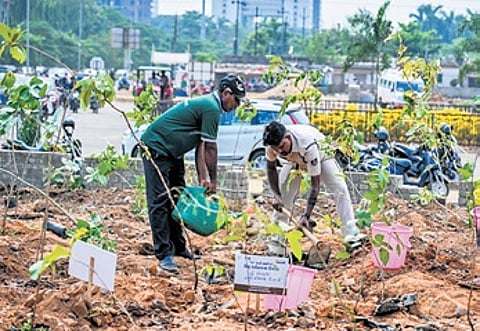

BHUBANESWAR: Housing and Urban Development minister Krushna Chandra Mahapatra said that Bhubaneswar Municipal Corporation (BMC) will develop 10 new Miyawaki forests across the state capital during the 2026-27 financial year, with a target of planting 60,000 trees during the ensuing monsoon season.
After planting saplings for a Miyawaki forest at Hatiashuni on the occasion of World Environment Day, the minister said that over the past two years, more than 75,000 trees have been planted at 15 locations in and around the city using the Miyawaki method, many of which have now matured into dense urban forests with trees exceeding 10 feet high.
He said Miyawaki plantations are being expanded at several locations, including urban forests, APJ School ground at Ghatikia, Nayapalli Haja area, Kalinga Nagar K-6 and near Kalinga Studio, as part of efforts to make Bhubaneswar greener, cleaner and more environmentally sustainable. The programme is being implemented in collaboration with the city and Chandaka forest divisions.
Highlighting the growing concerns over rising temperature and air pollution, Mahapatra said large-scale tree plantation remains one of the most effective measures to combat climate change, improve air quality and create healthier urban environments. He underlined that Bhubaneswar currently ranks among the cleanest-air cities in the country and urged citizens to contribute towards making it the nation’s top city in air quality.
Mayor Sulochana Das said BMC has already completed preparations for planting 60,000 saplings this year with support from the forest department. As part of the campaign, around 3,000 saplings were planted at the Hatiashuni site, while another plantation drive was conducted around a water body in Prachi Vihar under Ward no-18.
Commissioner Chanchal Rana said the Miyawaki method allows plantation densities of 8,000 to 10,000 trees per hectare, compared to around 1,600 trees under conventional plantation methods. “The technique involves planting native species closely together, enabling faster growth and the development of dense forests with minimal maintenance. The plantations will include 24 native species such as neem, mango, kadamba, jackfruit, karanja, amla, bel, jamun and other locally adaptable trees,” he said.
