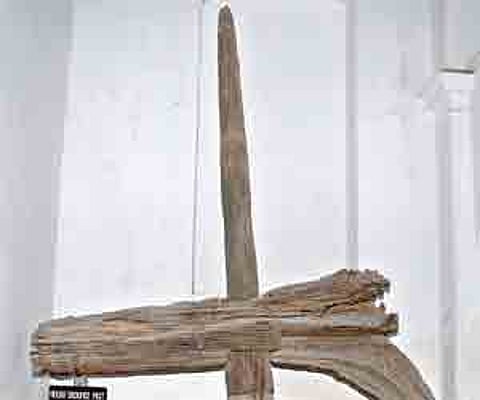

CHENNAI: One of the exhibits that will be thrown open for public viewing soon at the Government Museum, is a wooden structure telling a chilling tale of human sacrifice.
Known as ‘Meriah sacrifice post’, the wooden structure was used by the tribal Kandhas around 150 years ago, in the present day Orissa.
The exhibit in the Anthropology gallery, that has been closed for the past few years, is the only specimen left of the sacrifice post.
It was brought from Baligudu in Ganjam of Orissa during the end of the 19 th century by Colonel Pickance, the then Assistant Superintendent of Police and preserved carefully in the museum.
The Kandhas, whose bloody feud with the Panas was in the news last year, had the barbarous practice of sacrificing human beings to their earth goddess, ‘Tari Pennu’, to ensure good crops, health and prosperity.
This practice had been going on for hundreds of years before it was halted by the British by the end of the 19th century.
The victims used to be placed on a five-foot horizontal wooden slab fixed on a six-foot vertical pole. The sacrificial attendants used to hold the outstretched arms and legs, with the body suspended horizontally from the slab.
The victim was referred to as ‘Meriah’ and intoxicated with toddy and anointed with oil before the ‘offering’ to the earth deity. People used to apply the oil from the victim’s body on their head and go on a procession to the accompaniment of music.
The tribals then circumambulate the pole, rotating and rocking the victim on the slab and at times also hitting the helpless soul continuously, before killing him with a sacrificial knife.
A vivid account of the purchase of the victims, their treatment and their pathetic killing are described in the renowned work of ‘Castes and Tribes of Southern India,’ (1909) by Edgar Thurston, a noted British museologist and ethnographer, who was the Superintendent of the Government Museum, Chennai, during the 19th century.
A group of Kandhas, who came to Chennai in 1906 to perform a cultural event before the Prince and Princess of Wales, were excited to see the only remaining relic of their former custom.
Soon, visitors to the museum will be able to see this rare glimpse at our past, once the Anthropological section is thrown open to public.