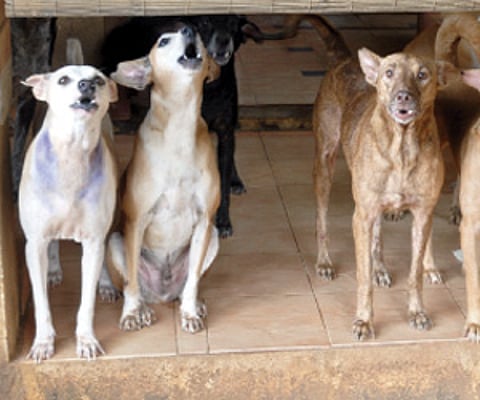

CHENNAI: Ever seen a street dog with a clipped ear and wondered how it got the injury? The clipping is intentional. It is meant to tell you that the dog was part of the Animal Birth Control-Anti-Rabies (ABC-AR) programme, so it will not procreate and is safe.
In Chennai, animal welfare organisations Blue Cross, People For Animals (PFA) and Society for the Prevention of Cruelty to Animals (SPCA) carry out the ABC-AR programme on both male and female dogs. While PFA and Blue Cross handle North and South Chennai respectively, SPCA takes up some cases in Central Chennai. The Corporation acts as a facilitator, extending the services of its dog catchers.
So, what is the current population of strays in the city? The figure depends on whom you are talking to. But first things first. “Don’t call them stray dogs. They haven’t strayed away from their natural habitat. Call them street dogs instead. They serve the community,” asserts Blue Cross co-founder Dr S Chinny Krishna.
Now, the stats. According to the Corporation’s veterinary department sources, there are about 1-1.20 lakh street dogs in the city. But Dr Krishna puts it at under 40,000.
Sources in the Corporation’s veterinary department claim that 80 to 85 per cent of the street dogs have already been covered under the ABC-AR programme. In 2009-10, 22,210 dogs were caught for sterilisation. Of this, PFA covered 11,273, Blue Cross 10,206 and SPCA around 600.
According to sources, North Chennai has the highest population density of street dogs as people there treat them as community dogs and feed them. “Even now, they throw stones at dog catcher units assuming that we forcefully take dogs away,” the sources add. Most of the complaints on street dogs are from the south, like Anna Nagar.
FUNDS, INFRASTRUCTURE
What does it cost to sterilise a dog? Blue Cross spends around `600 to `700 per dog, but the Animal Welfare Board of India (AWBI) — the nodal agency that funds the ABC project — reimburses `445 for each sterilised dog. That is way below the actual cost, admits AWBI chairman Major General (Retired) Dr R M Kharb. As AWBI functions under the Union ministry of environment and forests (MoEF), the board has suggested to the ministry to revise the per dog allocation. “I am waiting for a favourable response,” says Dr Kharb.
The procedure for animal welfare organisations seeking fund reimbursement is as follows: By April each year, the Corporation provides each of them a document certifying the number of dogs it sterilised during the last fiscal. The organisation submits that document to the AWBI, but reimbursement takes time.
Besides, there have been allegations on non-receipt of AWBI funds from some quarters. AWBI officials here claim they exhausted the funds they received in September last and are waiting for the next installment to reimburse the money. Last year, the AWBI released Rs 3.92 crore for sterilisation activities across the country.
The Corporation says it meets all the infrastructure needs of welfare organisations working in this field. “We give medicines, including anti-rabies vaccine, to the PFA. We can even provide the feeding cost if the organisation furnishes the necessary documents. Also, we have provided a facility for sterilisation to the PFA with an operation theatre and 14 kennels at Choolai. For Blue Cross, we have set up a similar centre at Lloyds Road. The corporation foots the bill for water supply, electricity and all other basic amenities,” informs Deputy Commissioner (Health) Ashish Kumar IAS.
Not enough, says Blue Cross. “I have been in this field for over 50 years now. The Chennai Corporation has never paid us anything for our activities. We sterilise, feed the dogs during the post-operative period of five days, provide medicines and rehabilitation. On an average, we sterilise 900 to 1,000 dogs and spent more than Rs 5 lakh a month. With the rising fuel cost and other expenses, our pocket is fast getting empty,” Dr Krishna rues.
Veterinary department sources add that the Corporation uses six vehicles for the ABC programme and employs 20 private dog catchers who get `25 per dog.
“We have set up pet clinics at Thiru-Vi-Ka-Nagar and Nungambakkam. All the services and medicines are free. Dog licensing is also done there,” Kumar adds.
SMALL PLAYERS, BIG SERVICE
While big organisations have access to funds, individuals working for animal welfare seldom get any. They depend solely on donors.
“It is very difficult. People who have devoted their lives to the care of street dogs do not get public recognition. They get a big zero,” says Prasanna Thyagarajan of Kottivakkam, who donates Rs 10,000 every month towards the cause.
Rosalind Rengarajan, who runs Sheba Vet Care clinic at St Thomas Mount and takes care of nine street dogs, says, “My friends and relatives always help by donating money. I save, even if it is Rs 5, as it serves the purpose in the long run.”
Dr Latha MBBS of Neelangarai have been hit hard by debt. “I was caring for 13 dogs and 100 cats. Now a private financier has taken possession of my house and my animal shelter is in shambles,” she claims.
Mercy killing
Not all dogs that are caught are sterilised. Some with diseases, often infectious, are euthanised as they pose a risk to the health of other dogs. “If a dog with viral diseases, such as canine distemper, is sheltered with healthy ones, chances of the latter getting infected are high. So, it is better to give it a sodium pentothal shot for the greater good,” says Blue Cross manager V Daniel. He, however, adds that the number of euthanised dogs is negligible. Sources at the Chennai Corporation’s veterinary department also admit that a few dogs in bad health are killed. “At present, the Corporation provides sodium pentothal doses to People For Animals,” sources add. Daniel denies allegations from certain quarters that dogs in good health are euthanised. “Why should we do that when we work for animal welfare?” he asks.
Dog days redefined
If street dogs are an eyesore, pedigrees are darlings of their masters. The number of pedigree dog owners is going up each year, with Chennai keeping pace with the trend.
According to V V Subramanian, administrator of The Kennel Club of India (KCI), the demand for pedigree dogs in Chennai grew at close to 10 per cent a year in the last decade, as compared to the national average rise of 15-20 per cent during the same period.
The KCI, with its headquarters in Chennai, is the parent body in India for registering pedigree dogs. It has international affiliation with Fédération Cynologique Internationale, Kennel Club of UK and the like, claims Subramanian.
“Basically, we are a registering and certifying agency. To get the KCI certification, a dog should meet breed standards that are defined through certain norms of the club. We advocate purebreds. Also, microchipping – a chip is injected into the dog’s neck – is mandatory for a KCI certified dog. This helps keep track if it is lost and ensures that no crossbreeding takes place,” Subramanian says.
In all, 56 kennel clubs across the country are affiliated to the KCI. The affiliated clubs organise dog shows — mainly between October and February — for which they need KCI’s approval for dates.
But why hold dog shows? “Shows ensure that the progeny maintains the qualities required for each breed. They also popularise different dog breeds among the public. Indian breeds like Rajapalayam, Mudhol Hound and Chippiparai participate in shows here. To get them international recognition, we are compiling information to fix their breed standards,” he says.
According to Subramanian, 40,000 to 50,000 new registrations happen each year. People now take more interest in showing off their dogs. “A KCI registration is like an ISO certificate. It assures breed quality. When sold, a KCI certified dog would definitely fetch a better price than the one without it. Also, only a dog with KCI certificate can participate in dog shows,” points out Subramanian.
If dogs can have certificates, why not a spa? Chennai’s first pet spa is just five-month-old, but it gets a good ‘pawfall’ everyday. “On an average, we groom seven dogs a day. At peak time, it can be 12 to 15,” says Sundar Ramaswamy, owner of Kabbs Pet Spa and Boutique in Alwarpet.
Charges for grooming and styling a dog start at `500. Aromatherapy begins from `400. The cost varies as grooming and styling depend on the coat of the dog. For `2,500-3,000, you can get your pooch a Full Groom at Kabbs. “We get seven to eight Full Groom customers per month,” says the software engineer-turned-pet-groomer.
Besides, Kabbs has crossbreeds as customers. “Some people who adopted mongrels bring them here for brush and bath,” he says.
Not all pets are lucky though. “There are people who abandon dogs — whether it is pedigree or mongrel — after they get old. Also, many believe that only pedigree dogs can be their pets as they are very class conscious. Every dog is a dog. There is no such thing that one type of dog is gentler than others,” says Ranjit Daniels, founder and managing trustee of Care Earth Trust.
According to Soumya Suresh, a housewife from Anna Nagar, pedigree dogs are obedient and easy to train, unlike street dogs. “I spend nearly `15,000 a month on my Basset Hound. He gets the best food, but I don’t take him to shows because I don’t believe in flaunting dogs. My dog is not certified by the kennel club. I am not aware of it. And I don’t see any reason to register either,” she says.
