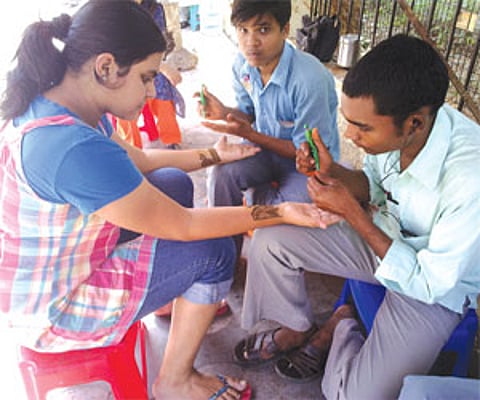

Shopping areas in Chennai are crowded almost all the time. Amid the maddening hustle-bustle on the streets of Sowcarpet, T-nagar and Pursaiwalkam, you’ll find a few people sitting on a wooden stool hunched over a pair of hands. They are mehndi artists who create the intricate designs minus any fancy furniture or equipment. All they have is a bag with a dabbas of homemade mehndi paste and a couple of stools near them for the customers to sit.
Harendra Singh, a 23-year-old from Sowcarpet has been a mehndiwallah for three years. “I did some technical studies from the ITI College in Punjab. However, I was always drawn towards this art.” Hailing from a family of cloth traders, Harendra says that he has always received the support of his family members. “I get about 15 to 20 customers everyday. On an average, I earn Rs 4,000 -5,000 per day, which is more than what other professionals draw. My family is also happy as my job makes many people happy.”
Catering to customers at T-nagar, the 24-year-old BS Shivam belongs to a family of henna artisans. Having no formal education as such, Shivam says, “I have been a mehndi designer from the past 10 years. I receive around 20-25 customers, to whom I cater with the help of my assistants,” he says. He also has a few mehndi designers who work for him in other commercial areas across the city. “We have a lot of customers in T-nagar, as it is always a busy area. We distribute the money amongst ourselves at the end of the day.”
Shivam also undertakes special orders for marriages and events, and believes that Diwali is the luckiest time of the year for them. “Customers flock to us as Diwali approaches. We have attended customers till about 4am sometimes.”
Sitting further away from him is the 20-year-old Ganesh from New Delhi. Though relatively new to the trade, he receives about 15 customers in the evening. “There is a lot of competition these days and I try my best to offer good service to my customers.” He says the henna comes all the way from Delhi. “We just mix it with water and make a paste out of it. But before the application begins, we put some drops of eucalyptus oil on the customer’s hands to enhance colour and texture.”
Priya, a customer at his stall, frequents the mehndiwallahs only on special occasions. “My friend is getting married at the end of this month. I’m getting the Arabic style as it has a lot of floral patterns.”
Despite their soaring popularity, not all mehndiwallahs earn good money. Take the 24-year-old Birju Singh and his younger brother Satendre in Purasaiwalkam, for instance. “There’s too much competition and street-side mehndiwallahs are aplenty these days. Suddenly I’d get 10 to 12 customers and sometimes we are forced to sit idle all day. Customers are very demanding. They know the latest trends and styles and ask us for unique designs.”
These artists know many mehndi styles like silver, golden, Arabian, Rajasthani and Marwadi. “Each one is quite different from the other,” explains Birju. “Women use the golden and silver styles to match their dresses. The Arabic style is thick and bold while the Rajasthani style requires more detailing and intricacy. The Marwadi style involves a lot of floral designs and is mainly used in marriages.”
Malavika, a customer in Sowcarpet, says that the mehndiwallahs are “very quick, clean and professional in their approach. Proximity also matters as I live in the same area as well.” Afrein, another customer in Purasaiwalkam concurs and adds, “These days none of us have the time to sit and put designs to ourselves. These mehndiwallas are very quick and professional, and the colour also turns out well.”
(If you need their services, call Birju Singh at 9176938904 and BS Shiva at 9444662394)
