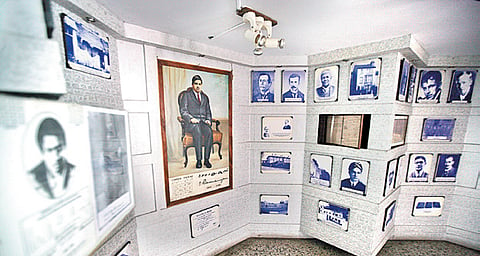

Though he was just an ordinary boy from Kumbakonam, Srinivasa Ramanujan made extraordinary contributions to mathematical analysis, number theory, infinite series and continued fractions. If they seem like Greek and Latin to you, it posed no problem for the ‘natural genius’, as English mathematician G H Hardy termed him.
However, this genius may have been lost to the world if it had not been for the city of Madras, now Chennai. Ramanujan completed high school with good marks and was offered a scholarship at the Kumbakonam Government College in 1904. As he failed to concentrate on anything but mathematics, his marks in other subjects tumbled and the scholarship was withdrawn. With little to no money, he left for Vizag. In 1906, Ramanujan came to Madras with the sole aim of graduating in Fine Arts from Pachaiyappa’s College and securing a seat in the University of Madras. Yet again his love for numbers overshadowed all, he failed in all subjects except maths.
In spite of this, he found many supporters and well wishers in the city. ATB Bose, secretary and co-founder of the Ramanujan Museum and Math Education Centre in Royapuram, says that his public mathematical career began in Madras. “For a few years, he concentrated on his mathematical work, was seriously ill and underwent an operation and got married to Janakiammal. In 1912, he applied for the post of clerk in the accounts section of the Port Trust and was recommended by E W Middlemast, who was the Professor of Mathematics at the Presidency College. This shows that the man was recognised in academic circles,” says Bose.
He gradually started getting exposure to the modern world of mathematics. It was during that time, the Chief Accountant for the Madras Port Trust, S N Aiyar, published a paper on the distribution of primes in 1913 on Ramanujan’s work. After a few unsuccessful attempts contacting the greatest mathematicians of the day, Ramanujan got an encouraging reply from GH Hardy.
A recommendation from him resulted in a two-year scholarship from the University of Madras. Hardy later took him to Trinity College in Cambridge. “Ramanujan left the country from Madras and came back here. He spent his final days in a bungalow at Chetpet. If it was not for his admirers and the mathematical community here, he would have died without anyone ever knowing his work,” says Bose.
