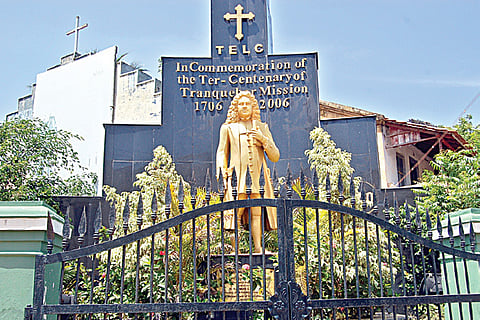

This young German Missionary who landed on Coromandel coast 306 years ago changed the way people read Tamil. But, Bartholomäus Ziegenbalg is not recognised for the several firsts he had achieved in a short span of 13 years.
Ziegenbalg was just 22 years old when he arrived in India on July 9, 1706 along with an elder companion Henry Plütschau. They were chosen by King Frederick IV of Denmark to minister to the fledgling Danish settlement of Tranquebar (Tharangambadi).
On arrival, they faced several difficulties, primarily that of language. However, Ziegenbalg learned Tamil so quickly, that he may have been a naturally-gifted linguist, say Christian historians.
Ziegenbalg was the first Protestant missionary to the country and was the first to translate and print the New Testament of the Bible into Tamil.
Solomon Rajkumar, a Christian historian, says, “The missionaries had their first converts eight months after they landed. From Ziegenbalg’s writings, we can see that he felt the need for books in the native language Tamil.
Apart from this, he had a keen interest in knowing the latest developments in printing presses.” These two interests combined and the first ever regional language to be put into print was Tamil - in a small pamphlet called ‘Nirubam’.
His first Indian student and associate was Rev C Aaron Samuel Aarumuga Pillai, who went on to become the first non-European ordained priest anywhere in the world.
Rev Samuel’s eighth direct descendent, also called Aaron Samuel says that Ziegenbalg is not recognised as much as he should have been even today. “He brought printing to India almost a whole century before William Carey actually did; he even made a Tamil dictionary. He started the first theological seminary, paper mill and was instrumental in starting the first school for girls. In 13 years, he completed all these achievements,” says Aaron, who is a music master in a city school. Ziegenbalg died at the age of 37, on 23 February 1719, after laying the foundation for the Lutheran church which functions even today. In Tranquebar, there still exist several schools and churches that were built by him. Aaron says, “He left an enduring legacy, not only to the Christians, but also to Tamil.”