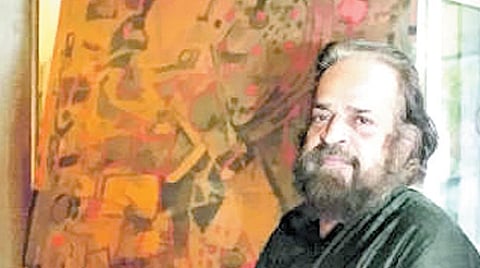

Painter, co-founder of the Cubist movement, inventor of constructed sculpture and co-inventor of the collage, Pablo Picasso wore many hats during his lifetime. Even today, artists find it difficult to not be influenced by the man’s work. Achuthan Kudallur, a prominent abstract artist, says, “Earlier, in my drawings, I was influenced by Picasso, especially in the stylisation.”
He calls Picasso’s work an “overpowering influence” especially on young artists. “We see and assimilate so much of his work that it unknowingly creeps into our work. That is not necessarily a good thing; each artist must find their own style,” says Achuthan.
Born on 25 October 1881, Picasso was christened with the impossibly long name of Pablo Diego José Francisco de Paula Juan Nepomuceno María de los Remedios Crispiniano de la Santísima Trinidad. Ruiz and Picasso were tacked on to represent his father and mother respectively, as per Spanish law. A prodigy, he made it into the Barcelona School of Fine Arts at the age of 13. Since then, he continued to take the art world by storm.
A V Ilango of Ilango’s Artspace says that while Cezanne was the father of Cubism, Picasso was the one who was bold enough to bring it out. “Indian artists never had the tendency to do three dimensional arts in those days. Picasso too tried to do a similar thing in a different way. In that way, he has really influenced Indian artists because we already have the tendency to work on a single plane,” he says.
Ilango adds, “In the early 70s and 80s, I leaned towards Van Gogh and Matisse. However, when it comes to understanding colours, Picasso was my greatest influence – his colour sense was amazing.” Speaking of how the character, tone and texture of each colour could affect the way the painting was interpreted, he says, “A painter should know to read and enter a painting. Only then is he a true artist. In that sense, Picasso’s paintings are like a dictionary. Primarily through studying his works and of other artists, I mastered my application of colour.”
Sharan Apparao, of Apparao Galleries, says that the interest in international art was not rampant in India when Picasso was alive. “Right now, there are people showing interest mainly in his etchings. But when he was alive, it was only those artists who went to France and met him who had any contact with his work,” she says.
Of these, Sharan says it was only F N Souza who took the most from Picasso. “Souza took a lot of energy and inspiration from Picasso, complete with the bohemian mindset. Others who met him were merely impressed by him, but did not so wholly fall into his way of thinking and living,” she says, adding that it is only now that art has become glamorous in India, but it was not the case during Picasso’s time.
