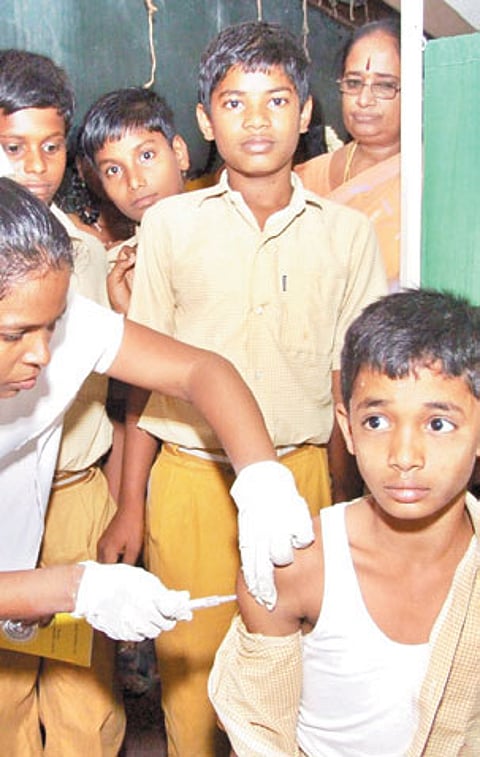

With seven states including Tamil Nadu introducing pentavalent vaccines (apart from the union territory of Puducherry) in their immunisation programme, child mortality and morbidity is set to reduce drastically in the country.
Dr Ajay Khera, Deputy Commissioner, Child Health and Immunisation, Ministry of Health and Family Welfare, says, “So far we have been able to cover five million children with this vaccine. This one-shot vaccination will drastically reduce child mortality in India by preventing diphtheria, tetanus, whooping cough, hepatitis B and Hib.”
In India, pentavalent was introduced in Tamil Nadu and Kerala in December 2011. Recently Delhi and Jammu and Kashmir included pentavalent vaccine in their state immunisation programme after Haryana, Puducherry, Goa and Gujarat. More states are slated to include pentavalent vaccine in their state immunisation programme.
Hib vaccine has been introduced in more than 180 countries worldwide including the neighboring countries of India including Pakistan, Bangladesh, Sri Lanka et al. All these countries are currently administering the pentavalent vaccines.
The pentavalent vaccine helps in reducing the number of shots a child receives from nine to three. It also provides logistical conveniences since five vaccines are stored in a single vial and a lot of space will be freed up for storage and transportation.
A single auto-disable syringe is used instead of three per child, thereby substantially reducing the plastic and sharp waste.
Infants are given three doses of the pentavalent vaccine at the sixth, 10th and 14th weeks of age. After that, they need a booster dose of DPT and Hib at 15 to 18 months of age. The vaccine follows the normal immunisation schedule and can be integrated into the immunisation programme of the country.
According to World Health Organisation (WHO) in India, today, pneumonia is one of the largest killers among young children aged one month to five years of age. Haemophilus influenzae type b (Hib) bacterium, which causes pneumonia and meningitis, is estimated to cause an estimated 2.4 to 3 million serious cases and 72,000 deaths in India annually.
In many developing countries, the immunisation schedule goes beyond the basic six vaccines.