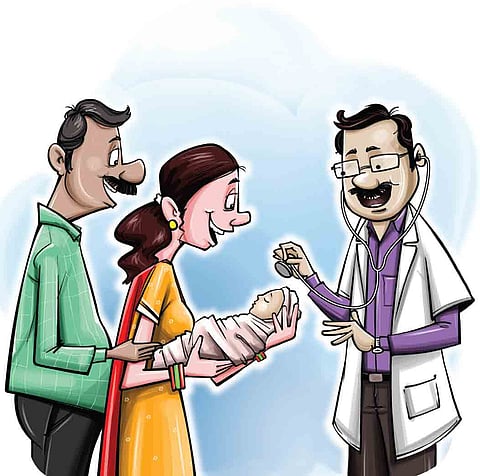

Are you a proud and a happy parent of a newborn? Have you screened your baby to check on the development of the thyroid gland? Paediatricians and gynaecologists insist that every newborn should be screened within three days of birth as there is a high risk that the infant could be suffering from congenital hypothyroidism (CH).
City doctors point out a study by the Indian Council of Medical Research (ICMR)in which doctors screened over 30,000 newborns and found an alarming incidence of 1 in 832 newborns in Chennai suffering from CH which is a precursor to cretinism.
Creatinism is a condition that leaves a child with severe stunted physical and mental growth.
“The incidence in Chennai is higher than that of the national level where it is 1 in 1,172. There needs to be more awareness on the importance of newborn screening,” said child specialist Dr Sudha Rathna Prabhu.
Congenital hypothyroidism could be anything from a missing to a misplaced thyroid gland. Sometimes the gland could even be located under the tongue of a newborn.
In cases of drug-induced CH, it happens if the mother had been treated with anti-thyroid drugs during pregnancy. Some cases may be familial too.
If not diagnosed early and treated, it could lead to mental retardation and improper growth, a damage that will be irreversible.
Hence, doctors insist that all newborns undergo a screening test that costs around `1,000 within three days of birth or at the most within seven days. The test on a newborn is a simple heel prick filter paper blood sample and if it is positive, then the test should be repeated after four to five days from the first test.
“Treatment should be started when the child is of three weeks and usually continued up to four to five years, doctors do not risk on stopping the treatment. Every three to six months, the baby would be monitored for development and growth,” explained Dr Sharadha Srinivas, Neonatologist and Pediatrician. The baby would be given a synthetic thyroid hormone, which is similar to the hormone made by a thyroid gland, orally as doctors said in case of absence of the gland, the treatment would be lifelong.
But if left undiagnosed and untreated, it will be worse. The baby would show symptoms of prolonged jaundice, constipation, sluggishness, sleepiness and lack of interest in the first month of life.
“The baby would sleep a lot and would not cry that much and would have umbilical hernia,” Dr Sharadha explained. In many cases, the deficiency of the hormone is severe and symptoms develop in early weeks of life while if there is a lesser degree of deficiency, symptom appearance may be delayed for months. But it will eventually affect the mental and physical growth of the baby, doctors added.
Medical experts advise parents to volunteer and ask their doctors to conduct newborn screening. “They can even ask their gynaecologists so if their hospitals do not offer the screening, they can do it outside. Though some hospitals do offer it, not all centres routinely do it. Also people need to have more awareness on the importance of new born screening,” said Dr Uma Ram, Gynaecologists.
Apart from CH, the newborn screening can also help diagnose other disorders including congenital adrenal hyperplasia, galactosemia, cystic fibrosis and G6PD.
