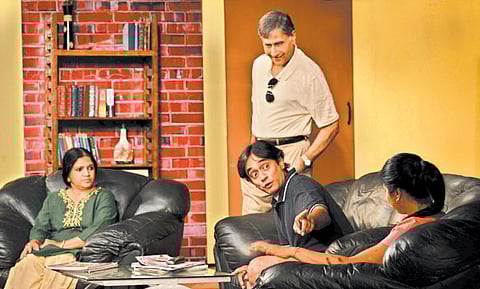

The thing about plays dealing with women’s issues is that it’s always relevant, no matter what century it is staged in. The setting doesn’t matter either — whether it is a 1960s period drama where old-fashioned themes of purity and chastity are abound, or a contemporary setting where sexism is cloaked in sweetened words of advice.
That’s where Poile Sengupta’s Mangalam hits the nail on the head for its treatment of both eras. Performed by the Madras Players, in association with Crea-Shakthi, over the weekend at the Museum Theatre — the play showed the audience why such themes of sexual abuse, rape and domestic violence were still relevant, even after 20 years of it being written.
The first half of the play, directed by Abhinav Suresh, was filled with what one would dismiss as the previous generation’s inherent chauvinism — “It’s different for a man!” and “Stop these silly women fights!”. But those undertones were the ones that brought out the life of one man who was haunted by his wife’s past. The second half was completely different from the first, but it still managed to channel that essence of the first half.
P C Ramakrishna as the tortured husband of the eponymous Mangalam and the modern day dad, fit perfectly into both the moulds. So it wasn’t at all surprising that all the young girls in the audience whistled at his costume change that made him go from 1960s wife-beater to chic, uber-cool dad. Sumitra N Gautama, the other anchor of the play, saw an equal transformation — from bitter widow to a conflicted housewife.
The biggest stunt that performers pulled off on stage was the casting of the youngsters — Murali Satagopan, Vinithra Madhavan Menon, Vaidhya M Sundar and Nayantara Nayyar. With two roles to play on stage instead of one, these four seemed to be the favourite of the audience — presumably because they could connect with them.
Venkatraman Balakrishnan and Dharma Raman as friends of the family in both halves, were adequate. Sets and lights by Victor Paul Raj sealed the deal for the play, while a haunting veenai, played by Bharadway Raman, set the tone of the play beautifully.
For the audience, which largely comprised young school girls, it was a treat to watch something that was as unlike the present era as it could get — and still connect to it in a way they couldn’t with plays from this generation. And that is the biggest success of Mangalam.